
Predicting the Stock Market: Why Even Experts Get It Wrong

Updated: Mar 30
David retired in March 2025 with $2.3 million*. Two weeks later, tariffs hit.
The S&P 500 dropped roughly 12% in four days. Every headline screamed recession. His advisor's firm slashed their year-end forecast.
David moved $800,000 to cash.

By June, the market had recovered to all-time highs. David's cash was still sitting on the sidelines. The cost of listening to the experts? Roughly $92,000 in missed gains — in three months.
Here's the uncomfortable truth: the people Wall Street pays millions to predict the stock market are wrong more often than a coin flip (CFA Institute).
And if you're retired or approaching retirement with $1 million or more, acting on those predictions can do more damage than any bear market ever could.
The data says it clearly. Chasing predictions costs the average investor $371,889 for every $100,000 invested over 20 years (DALBAR via Kirr Marbach). That's not a typo. And you're about to see exactly how that number is calculated.
Key Takeaways
Wall Street forecasters miss by an average of 19 percentage points per year. In 2024, the most bullish forecast still underestimated the S&P 500 by roughly 10 points (Avantis Investors).
In 2024, investors trying to time the market guessed right just 25% of the time — tying a record low set by DALBAR's "Guess Right Ratio" (DALBAR via PR Newswire).
65% of professional fund managers lost to the S&P 500 in 2024. Over 15 years, not a single category of active managers beat their benchmark (SPIVA via Institutional Investor).
Missing just the 10 best trading days over 30 years cuts your returns in half. And 78% of those best days happen during or right after a bear market (Hartford Funds).
The behavior gap costs real money: $371,889 per $100,000 over 20 years. On a $2 million portfolio, that pattern can erase more than $7 million in potential wealth (DALBAR via Kirr Marbach).
For retirees, the stakes are even higher. Sequence-of-returns risk means a badly timed sell-off in your first five years of retirement can permanently shorten how long your money lasts — even if the market recovers.
Want the full breakdown? Keep reading.
The Forecasting Track Record: Worse Than You Think
Here's a question worth $7 million: If the smartest analysts at Goldman Sachs, JPMorgan, and Morgan Stanley can't predict where the stock market is headed, why would anyone base retirement decisions on their guesses?
The track record is staggering. From 2018 through 2025, the median Wall Street S&P 500 forecast missed the actual return by an average of roughly 19 percentage points (Avantis Investors). Not 19 basis points. Nineteen full percentage points.
Let's zoom into 2024. The average Wall Street forecast predicted the S&P 500 would close the year at about 4,861. It actually closed at 5,881 — a miss of over 1,000 points. The most optimistic analyst predicted a 13% gain.
The actual return was over 23% (Larry Swedroe). Even the biggest bulls got it wrong by double digits.

One study of market pundits tracked hundreds of directional predictions — simply whether the market would go up or down. The accuracy rate? Just 47%. Worse than flipping a coin (CXO Advisory Group via Daner Wealth).
This isn't a new problem. Researchers Songrun He, Jiaen Li, and Guofu Zhou analyzed three major forecasting surveys and found that none of them outperformed a simple model that just assumed future returns would match historical averages (Larry Swedroe).
Billions of dollars in research budgets, and the result was worse than using a calculator and a history book.
And right now? Twenty-two Wall Street firms have published their 2026 S&P 500 targets. They range from roughly a 3.7% gain to an 18% gain (TheStreet). Every single forecast is positive. Not one firm predicts a down year. If history is any guide, many of them will be wrong — and several will be wrong by a mile.
The April 2025 Panic: A Case Study in Forecasting Failure
If you want to understand how predictions destroy wealth, look no further than April 2025.
On April 2, sweeping tariffs were announced. Over the next four trading days, the S&P 500 lost roughly 12%. The Nasdaq entered bear market territory. More than $6 trillion in market value evaporated in two days alone (CNN). Wall Street panicked. At least 15 of 20 major firms slashed their year-end S&P 500 targets (Avantis Investors).
By May, Bloomberg data showed Wall Street had collectively downgraded its year-end outlook to project just a 2% gain — the steepest revision since the pandemic (Fortune).
Then the market did what markets do. It recovered.
The S&P 500 turned positive for the year by May 13. By June 27, it hit an all-time high. The index finished 2025 up roughly 17% — making virtually every April downgrade wrong.
Now think about David. He heard the same forecasts. He watched the same cable news coverage. He moved $800,000 to cash based on what the experts were saying. He was doing what felt rational.
But by the time he felt confident enough to reinvest, the market had already bounced back. The best days happened when things looked the worst.
David didn't make a reckless decision. He followed the "smart money." The problem is, the smart money was wrong. Generic advice to "follow the analysts" or "reduce exposure during uncertainty" sounds reasonable. But the data says it fails — consistently, measurably, and expensively.

The Myth Buster: "This Time, the Experts Have Better Tools"
The Myth: Every year, forecasters talk about new AI models, better data, and sophisticated algorithms. Surely their track record is improving?
Why It Sounds Reasonable: Technology has transformed nearly every industry. It seems logical that better data and faster computers would produce better predictions.
The Truth: The SPIVA scorecard has tracked active fund managers for over 20 years. In 2024, 65% of active large-cap managers underperformed the S&P 500 — slightly worse than the 24-year average of 64% (SPIVA via Institutional Investor).
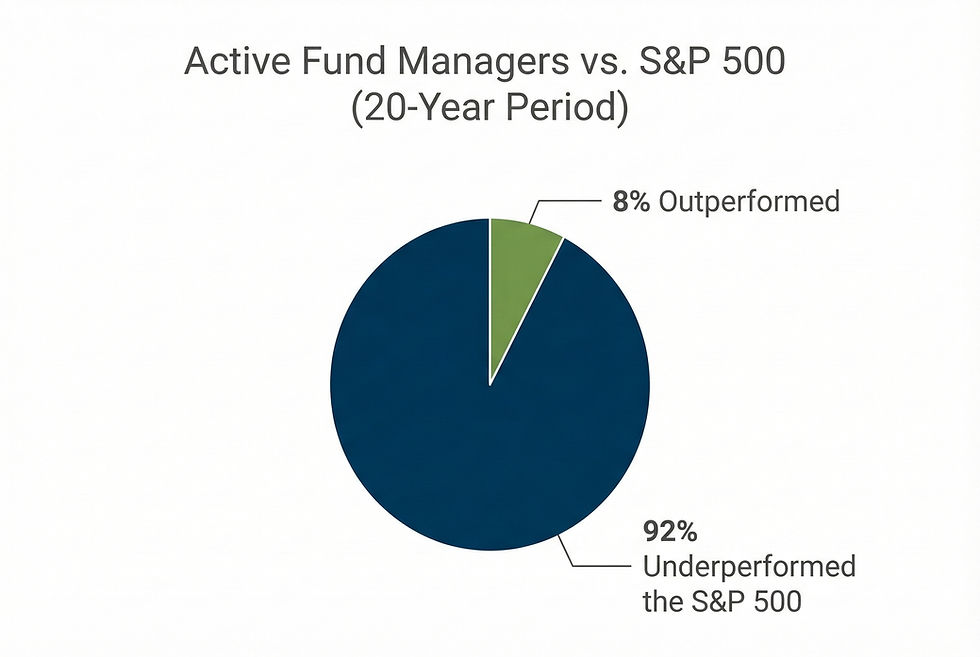
Over a 15-year period ending December 2024, there was not a single equity category where a majority of active managers beat their benchmark. Zero. Over 20 years, roughly 92% of active U.S. large-cap funds underperformed (SPIVA via One Day in July).
And performance persistence — the idea that this year's winners will be next year's winners — is a fantasy. Not a single top-quartile large-cap fund from 2020 stayed in the top quartile by the end of 2024 (SPIVA Persistence Scorecard via Evidence Investor). The hot hand doesn't exist.
The Cost of Believing the Myth: Nearly 64% of domestic stock funds were shuttered or merged over 20 years — conveniently erasing poor performance from the record (SPIVA via IFA).
If you keep chasing last year's winners, you're playing a game where the losing players literally disappear from the scoreboard.
The Hidden Connection: How Bad Predictions Trigger Sequence-of-Returns Risk
Here's the connection nobody talks about: Market predictions don't just affect your returns. They affect your behavior. And for retirees withdrawing income, behavior changes at the wrong time can permanently shorten how long your money lasts.
This is called sequence-of-returns risk — the idea that the order your returns come in matters more than the average. A 20% drop in Year 1 of retirement does far more damage than a 20% drop in Year 15.
Why? Because you're withdrawing money from a shrinking portfolio, leaving less to recover when the market bounces back.
Here's where it gets dangerous. A retiree with a $2 million portfolio drawing $80,000 per year who panics during a downturn and sells — even temporarily — doesn't just miss returns.
They lock in real losses at the worst possible time. And if they wait to re-enter until the market "feels safe," they've likely missed the best days of the recovery.
How many of the best days? According to Hartford Funds, 78% of the stock market's best days occurred during a bear market or during the first two months of a bull market — before anyone knew the worst was over (Hartford Funds).
So the retiree who sells during a crash "to be safe" and waits for clarity is almost guaranteed to miss the rebound. The math is ruthless:
Miss the 10 best days over 30 years, and your returns are cut in half.
Miss the best 30 days, and your returns drop by 83% (Hartford Funds).

For someone drawing income, that's not an abstract underperformance. That's the difference between money lasting until age 92 and running out at 79.
⚠️ Note: Sequence-of-returns risk outcomes vary based on withdrawal rate, portfolio allocation, and market conditions. The above illustration is directional, not a guarantee of specific outcomes.
The High-Net-Worth Reality
In 2024, DALBAR's "Guess Right Ratio", how often investors timed their moves correctly, fell to just 25%.
That means investors trying to time the market guessed right one out of four quarters. The other three quarters, they moved money in the wrong direction at the wrong time.
Meanwhile, the average equity investor earned 16.54% — while the S&P 500 returned 25.02%. An 8.48-point gap that illustrates how market timing almost always backfires. On a $2 million portfolio, that's roughly $169,600 left on the table in a single year.
And this was a good year.
The Behavior Gap: What Market-Timing Actually Costs
DALBAR has tracked investor behavior since 1985. Their 2025 report reveals a pattern so consistent it should be carved in stone: investors underperform the very funds they invest in — every single year.
In 2024, the average equity investor earned 16.54%. The S&P 500 returned 25.02%. That 8.48 percentage point gap was the second-largest in a decade (DALBAR via PR Newswire). It wasn't caused by bad fund selection.
It was caused by bad timing — buying after rallies and selling during dips.
Over the 20-year period ending December 2024, the average equity investor returned 9.24% annually versus the S&P 500's 10.35% (DALBAR via Lorica Partners). That 1.11-point annual gap sounds small. It isn't.
A $100,000 investment left untouched in the S&P 500 for those 20 years grew to approximately $717,503. The same $100,000, subjected to the average investor's buy-and-sell behavior, ended at roughly $345,614 (DALBAR via Kirr Marbach).

The difference: $371,889. Per $100,000 invested.
⚠️ DALBAR methodology note: The "average investor" return is calculated using fund flow data (sales, redemptions, and exchanges), not individual accounts. It captures the aggregate impact of timing decisions across all equity mutual fund investors. The comparison to index returns does not account for all factors including fees and taxes.
Scale that to a $2 million retirement portfolio. The behavior gap — driven by reacting to predictions, headlines, and fear, and by misunderstanding how average stock market returns can mislead investors — could cost north of $7 million over two decades. Even accounting for withdrawals, the compounding damage is enormous.
Forward this section to your CPA and ask: "Are we set up to avoid this pattern?"
Why Your Brain Works Against You (And What the Research Says)
It's not stupidity. It's biology.
Philip Tetlock, a psychologist at the University of Pennsylvania, spent 20 years tracking 82,361 predictions made by 284 experts across political and economic fields.
His conclusion: expert forecasts were barely more accurate than simple statistical models that just extrapolated from historical averages (Tetlock, Expert Political Judgment, Princeton University Press).
Worse, Tetlock found that the qualities that make someone a great TV pundit — confidence, a bold thesis, a clear narrative — are inversely correlated with forecasting accuracy. The louder the prediction, the more likely it's wrong.
A separate Federal Reserve Board working paper found that analysts' earnings forecasts for the S&P 500 contain errors that could have been predicted using publicly available data like GDP growth and inflation (Federal Reserve Board, FEDS Working Paper 2024-049). The information to spot the mistakes was right there.
Nobody used it.
This matters for your retirement because these predictions shape your instincts. When three analysts on CNBC say "sell," your gut agrees. When your neighbor sold in April 2025 and tells you at a dinner party, you wonder if you should too.
That instinct — the urge to act on expert predictions — is the single most expensive force in retirement planning.
What to Do Instead: The Framework That Makes Predictions Irrelevant
Let's come back to David one final time.
Here's what David's retirement could have looked like with a plan designed to ignore market predictions entirely:
Cash reserve: Two years of living expenses ($160,000) in high-yield savings. When the market dropped in April 2025, David wouldn't have needed to sell a single share. His bills were covered.
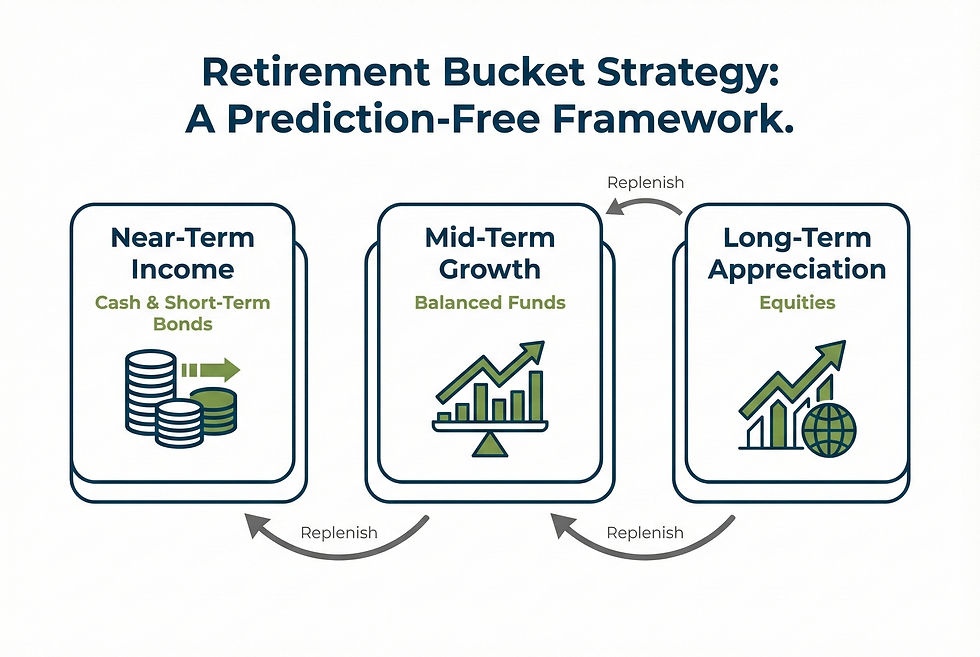
Bucket strategy: His portfolio divided into three time horizons — near-term income (cash and short-term bonds), mid-term growth (balanced funds), and long-term appreciation (equities). The near-term bucket insulates him from sequence-of-returns risk. The long-term bucket has decades to recover from any downturn.
Flexible withdrawal rules: Instead of a rigid 4% withdrawal, David adjusts spending slightly during down years. Spending $72,000 instead of $80,000 for one year can add years to portfolio longevity.
Roth conversion timing: Down markets are actually an opportunity. Converting traditional IRA assets to a Roth when prices are depressed means paying taxes on a smaller balance — and all future growth is tax-free.
[Disclosure: The scenario regarding "David" is a hypothetical illustration used to demonstrate planning concepts. It does not represent the experience of actual clients. Hypothetical results have inherent limitations, including that they are prepared with the benefit of hindsight and do not reflect actual trading or the performance of any specific client portfolio.]
The key difference? None of these strategies require David to predict where the market is going. They're designed to work regardless of what the market does next. That's the shift — from prediction-dependent to plan-dependent.
The trade-offs are real. A cash reserve means that $160,000 earns less than equities over time. Flexible withdrawals mean occasionally spending less than you'd like.
Roth conversions mean a tax bill today for a benefit years from now, especially when coordinated with an asset location strategy to minimize taxes in retirement.
But for retirees with $1M–$5M+, the math overwhelmingly favors a plan that removes the temptation to react to predictions.
⚠️ These strategies are planning concepts, not personalized recommendations. Your optimal approach depends on your specific tax situation, income needs, timeline, and risk capacity. Discuss implementation with a qualified advisor.
Wealth-Tier Reality Check
These strategies play out differently depending on portfolio size.
At $1 million, a two-year cash reserve ($160,000) is 16% of the portfolio — a significant allocation away from growth. The math still works, but the margin for error is tighter.
At $3 million, that same cash reserve is just 5% of the total. The portfolio has far more room to ride out volatility without behavioral pressure.
At $5 million+, the cash reserve is a rounding error. The real value of a plan at this level is in tax optimization — coordinating Roth conversions, managing capital gains, and structuring withdrawals to minimize the overall tax burden across decades
No matter the tier, the principle is identical: structure removes the temptation to predict.
Here's What You Can Check Right Now
Before scheduling any meeting, pull up these numbers yourself. Tell yourself WHERE to look, WHAT to compare, and WHAT it means.
Your cash reserve. Check your savings and money market balances. Compare to 12–24 months of essential living expenses. If you're below 12 months, you're vulnerable to selling equities in a downturn — the exact behavior that triggers the DALBAR gap.
Your 2024 account statements. Look at your total portfolio return for the year. Compare it to the S&P 500's 25.02% return. If you're significantly under, that gap is likely driven by timing decisions — yours or your advisor's.
Your withdrawal rate. Take your annual withdrawals and divide by your total portfolio value. If you're above 5%, sequence-of-returns risk is amplified. If you're above 6%, it's urgent — and revisiting IRA withdrawal strategies to maximize your savings becomes critical.
Your equity allocation. Log into your brokerage or 401(k) and check the percentage in stocks versus bonds versus cash. Compare to where it was in April 2025. If it dropped significantly and never recovered, you may have inadvertently "timed" the market.
Your advisor's investment policy. Ask for a written document that explains how withdrawal decisions are made during a downturn and how your tax plan is proactively incorporated. If the answer is "we'll assess at the time," you don't have a plan — you have a prediction.
The data is overwhelming. The average behavior gap costs $371,889 per $100,000 over 20 years. For retirees with $1M–$5M+, that's hundreds of thousands — potentially millions — in lost wealth. And it's driven by one thing: reacting to predictions instead of following a plan.
David didn't need a better forecast. He needed a retirement income framework built to make forecasts irrelevant. A framework that includes a cash reserve, a bucket strategy, flexible withdrawal rules, and tax-efficient conversion timing to reduce taxes on your retirement income.
Want Our Team to Just Do Your Retirement Planning for You? Schedule Your Strategy Session!
Investment Management — built around your retirement income needs, not a generic model
Tax Planning For Retirement — Roth conversions, withdrawal sequencing, IRMAA strategies
Retirement Income Planning — a clear plan so you know your money won't run out
Award Winning* | Fee-Only Fiduciary | Serving Clients Nationwide
Frequently Asked Questions
Should I Sell or Hold my Stock Positions?
In many cases, holding is the better choice — especially during a downturn. DALBAR data shows the average investor who times their trades guesses right only 25% of the time (DALBAR via Kirr Marbach).
Selling after a drop locks in losses and risks missing the recovery. Instead of asking "should I sell," ask "do I have enough cash reserves to avoid needing to sell?" That's the real question.
How Much Will $50,000 Be Worth in 20 Years in the Stock Market?
If the stock market returns its historical average of roughly 10% annually, $50,000 could grow to approximately $336,000 over 20 years.
But according to DALBAR, the average equity investor earns closer to 9.24%, which would leave you with roughly $291,000 — a $45,000 difference from behavior-driven mistakes alone (DALBAR via Lorica Partners). The key: staying invested matters more than picking the right entry point.
What is the 90% Rule in Trading?
The "90% rule" is an informal saying that roughly 90% of active traders and fund managers fail to beat the market over time. It's backed by real data: the SPIVA Global Scorecard shows approximately 90% of active equity fund managers worldwide underperformed their respective indexes over a 20-year period (Apollo Academy).
It's not a formal regulation — it's a statistical reality that reinforces why low-cost, stay-the-course strategies tend to win.
Why Can't You Predict the Stock Market?
Markets are driven by millions of participants reacting to events no one can foresee — tariffs, pandemics, geopolitical crises, policy changes.
Philip Tetlock's landmark 20-year study of 82,361 expert predictions found that forecasters were barely more accurate than simple statistical models (Tetlock, Expert Political Judgment).
Even the Federal Reserve found that analysts' errors could have been predicted using publicly available data — yet nobody corrected them (Fed Working Paper 2024-049). Markets are complex, adaptive systems.
Predictions will always fail because the future contains information that doesn't exist yet.
Can Financial Advisors Predict the Stock Market?
No — and the best ones don't try. Advisors who add value focus on tax planning, withdrawal sequencing, behavioral coaching, and risk management rather than market forecasting.
DALBAR research consistently shows that investor behavior — not fund selection — is the primary driver of underperformance (DALBAR via PR Newswire). A good advisor helps you avoid the $371,889-per-$100,000 behavior gap.
Is 2026 a Good Year to Invest in the Stock Market?
Twenty-two Wall Street firms have issued 2026 S&P 500 targets ranging from roughly 3% gains to 18% gains (TheStreet). Every single one predicts a positive return. History shows these forecasts are wrong by an average of 19 percentage points.
The better question isn't "is this a good year?" — it's "do I have a retirement income plan that works no matter what the market does this year?"
Ready to get your retirement portfolio on track?
Contact us today for a Free Strategy Session.

About the author:
Senior Financial Advisor
Adam is a Senior Financial Advisor with Covenant Wealth Advisors and a CERTIFIED FINANCIAL PLANNER™ practitioner. He has over 17 years of experience in the financial services industry in the areas of financial planning for retirement, tax planning, and investment management.
Disclosures: The scenario regarding "David" is a hypothetical illustration used to demonstrate planning concepts. It does not represent the experience of actual clients. Hypothetical results have inherent limitations, including that they are prepared with the benefit of hindsight and do not reflect actual trading or the performance of any specific client portfolio. Covenant Wealth Advisors is a registered investment advisor with offices in Richmond, Reston, and Williamsburg, VA. Registration of an investment advisor does not imply a certain level of skill or training. Past performance is no guarantee of future returns. Investing involves risk and possible loss of principal capital. The views and opinions expressed in this content are as of the date of the posting, are subject to change based on market and other conditions. This content contains certain statements that may be deemed forward-looking statements. Please note that any such statements are not guarantees of any future performance and actual results or developments may differ materially from those projected. Please note that nothing in this content should be construed as an offer to sell or the solicitation of an offer to purchase an interest in any security or separate account. Nothing is intended to be, and you should not consider anything to be, investment, accounting, tax, or legal advice. If you would like accounting, tax, or legal advice, you should consult with your own accountants or attorneys regarding your individual circumstances and needs. This article was written and edited by a CERTIFIED FINANCIAL PLANNER™ professional with the assistance of AI. No advice may be rendered by Covenant Wealth Advisors unless a client service agreement is in place. Hypothetical examples are fictitious and are only used to illustrate a specific point of view. Diversification does not guarantee against risk of loss. While this guide attempts to be as comprehensive as possible but no article can cover all aspects of retirement planning. Be sure to consult an advisor for comprehensive advice.


