
Pay on Death Bank Account: A Simple Way to Avoid Probate

The Carters spent thirty-two years saving, had a well-funded portfolio, and an estate plan their attorney called "bulletproof." Then Jim died, and Linda discovered something no one had mentioned: the $600,000 sitting across three bank accounts was frozen.
Not because of a legal dispute. Not because of taxes. Because Jim never filled out a one-page form at his bank.

That form — a pay on death (POD) designation — would have transferred every dollar to Linda the week Jim died. Instead, those accounts entered Virginia's probate system.
Linda waited 14 months. She paid more than $30,000 in executor and attorney fees on assets that could have transferred for free.
[Disclosure: The scenario regarding the "Carters" is a hypothetical illustration used to demonstrate estate planning concepts. It does not represent the experience of actual clients.]
One free form. Ten minutes at the bank. That's the difference between your family having immediate access to cash — and your family hiring a lawyer to get it.
Key Takeaways
A POD account bypasses probate entirely. Your beneficiary walks into the bank with a death certificate and walks out with the money. No court, no executor, no attorney.
It costs nothing to set up. Every major bank offers POD designations at no charge. You can change or remove them anytime.
Your will does NOT override a POD form. Under Virginia law, for example, the beneficiary form at the bank controls — no matter what your will says.
Skipping POD designations can cost your family $25,000+ in avoidable fees on a $2 million estate — plus 6 to 18 months of frozen cash.
POD has real blind spots. It doesn't help with incapacity, doesn't allow contingent beneficiaries at many banks, and doesn't protect assets from creditor claims.
For HNW families, POD works best as one piece of a coordinated plan — not a standalone strategy.
Remember that all of this information is general in nature — you should review our important disclosures about our firm and educational content and talk with your own professionals before acting.

What Is a Pay on Death Bank Account?
A pay on death bank account is a standard checking, savings, money market, or CD account with one addition: a beneficiary designation that tells the bank who gets the money when you die.
Think of it like an "if-then" instruction. While you're alive, nothing changes. You deposit, withdraw, and manage the account exactly as before.
Your beneficiary has zero access and zero rights. But the moment you pass away, the bank follows your instruction and pays the named person directly — outside of probate.
The related designation for brokerage and investment accounts is called transfer on death (TOD). Same concept, different account type. Both skip the courthouse.
To set it up, you fill out a beneficiary form at your bank. That's it. No attorney, no notary, no fee.
The Myth That Costs Families Thousands
The myth: "My will covers everything."
It sounds reasonable. You paid an attorney. You signed the documents. You filed them away. Of course your will controls what happens to your money.
It doesn't.
Virginia law is explicit: a POD designation on a bank account cannot be changed by a will. If your will says "leave everything to my three children equally" but your POD form names only your oldest — your oldest gets the account. The will loses.
This is one of the most common sources of estate disputes in Virginia. And the cost isn't just legal fees. It's family conflict that didn't need to happen — often compounding other retirement planning mistakes even savvy investors make.
The fix takes 10 minutes: review every bank account's beneficiary designation and make sure it matches your current estate plan. If you updated your will after a remarriage, a divorce, or the birth of a grandchild — check the POD forms. They don't update themselves.
Virginia law can extinguish former-spouse rights in certain multiple-party bank accounts after divorce, but beneficiary designations should still be updated directly with each institution, and ERISA retirement plans follow separate federal rules.
But this only applies to state-law-governed accounts. It does not override federal law for ERISA retirement plans like 401(k)s. If you're recently divorced, check every account — bank and retirement — separately.
What Your Bank Won't Tell You
Banks are happy to offer POD designations. They are not in the business of explaining what POD can't do. Here are three gaps that matter most for families with $1 million or more in assets.
Gap 1: POD doesn't help if you're incapacitated.
A POD designation triggers only at death. If you have a stroke or develop dementia, your named beneficiary cannot touch the account.
Your family may need to pursue guardianship or conservatorship proceedings — which are slower and more expensive than probate. A durable power of attorney fills this gap. A revocable trust fills it even better.
Gap 2: Many banks don't allow contingent beneficiaries.
If your sole POD beneficiary dies before you and you don't update the form, the account falls back into your probate estate.
The entire purpose of the designation is defeated. Review your POD forms every time a major life event occurs — death, marriage, divorce, birth of a grandchild.
Gap 3: Creditors can still reach POD funds.
Avoiding probate is not the same as avoiding your financial obligations. Under Virginia law, if the rest of your estate can't cover debts, taxes, or statutory allowances, POD beneficiaries can be required to return funds to settle those claims.
The two-year statute of limitations starts at the date of death.

This is the section to forward to your estate attorney. Send it with this question: "Are my POD designations coordinated with my will, trust, and power of attorney — or are they creating gaps?"
What a POD Designation Does to Your FDIC Coverage
Here’s a detail many people miss.
A payable-on-death (POD) designation does more than help an account avoid probate. In some cases, it can also increase the amount of FDIC insurance available at a single bank.
That matters more than most people realize — especially for retirees, business owners, or anyone keeping a larger cash reserve in savings, CDs, or money market deposit accounts.
Under current FDIC rules, POD accounts are generally treated as trust accounts for insurance purposes. In plain English, that means your coverage is often calculated based on how many owners are on the account and how many eligible beneficiaries are specifically named.
In general, the FDIC insures these accounts for $250,000 per owner, per named beneficiary, up to $1,250,000 per owner at one FDIC-insured bank.
Here’s what that can look like in real life:
Suppose a married couple has three adult children. If each spouse owns an account and names the other spouse plus the three children as POD beneficiaries, each spouse may qualify for up to $1,000,000 of FDIC coverage at that bank.
1 spouse x 4 beneficiaries x $250,000 = $1,000,000
Together, that can mean as much as $2,000,000 of total FDIC protection at one institution.
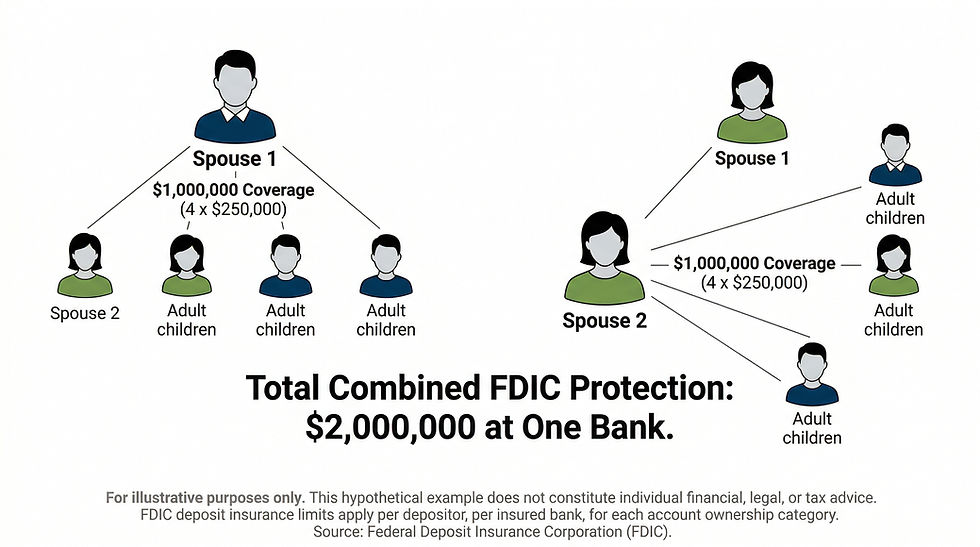
That is a very different outcome from the $500,000 many couples assume is the limit.
One important note: this only works when the beneficiaries are specifically named in the bank’s records. Saying something general like “my children” may not be enough. The bank needs the actual beneficiaries clearly identified.
Another key point: FDIC coverage rules can get complicated when you have multiple accounts at the same bank, different ownership structures, or trust accounts layered on top of one another. So this is not a strategy to guess at. It is something to confirm.
For families keeping $500,000 or more in cash at one bank, a quick review of account titling and beneficiary designations can be well worth the effort. In the right situation, a simple POD update may help your money pass more smoothly to your family and improve the amount protected by FDIC insurance.
The High-Net-Worth Reality
Your will doesn't control your bank accounts. The POD form does — and it beats the will every time under Virginia law.
Your POD designation doesn't protect you while you're alive. Incapacity? Your beneficiary can't help. You need a durable power of attorney or a trust.
Virginia probate tax itself is modest, but total estate-settlement costs can still rise depending on attorney fees, executor compensation, complexity, and whether disputes arise.
A POD form is free, revocable, and takes 10 minutes. Every dollar it moves out of probate saves your family time, money, and stress.
POD vs. Joint Account: Not the Same Thing
Remember the Carters? A well-meaning neighbor told Linda she should have "just added her name to Jim's accounts." It sounds like the same result. It isn't.
[Disclosure: The continued scenario regarding the "Carters" is a hypothetical illustration. It does not represent the experience of actual clients.]
Adding a joint owner to your bank account creates immediate co-ownership. That means your co-owner's creditors, divorce proceedings, and lawsuits can reach the account — while you're still alive.
If your adult child gets sued, your savings are exposed.
A POD designation gives you the same probate-avoidance benefit as joint ownership — without any of the lifetime risk.

When a POD Account Isn't Enough
For families with less than $500,000 in total assets, POD designations on bank accounts may be all the probate avoidance they need.
Virginia recently raised the small estate affidavit threshold to $75,000, which simplifies things further for modest estates.
But for families with $1 million to $10 million, a POD form is a starting point — not a finish line. At that level, the real question isn't "how do I skip probate?" It's "how do I make sure every piece of my plan talks to every other piece?"
A revocable trust offers what POD cannot: incapacity protection, contingent beneficiaries, asset protection for heirs, and centralized control.
The Carters' attorney had built a good trust. The problem was that three bank accounts were never funded into it — and nobody set up POD designations as a backstop.
A 10-minute conversation at the bank would have closed the gap.
This is the section to forward to your CPA to review how POD designations interact with RMD tax strategies and retirement withdrawals.
Here's What You Can Check Right Now
Before you call anyone, verify these five things. You can also work through a structured set of retirement planning checklists and yearly action steps to make sure nothing falls through the cracks:
Pull up every bank account you own. Check whether a POD beneficiary is named. If the field is blank, the account goes through probate. You can find this on your online banking profile under "account settings" or "beneficiaries" — or call the bank and ask.
Compare your POD beneficiaries to your will. If they don't match, the POD form wins. Ask yourself: is that what I intended?
Check for a contingent beneficiary. If your bank doesn't allow one (many don't), make a calendar reminder to review the designation annually — especially after any birth, death, marriage, or divorce.
Add up the cash across all accounts at a single bank. If the total exceeds $250,000 and you haven't named POD beneficiaries, you may be underinsured by the FDIC. If it exceeds $1,250,000, you may need to spread deposits across institutions.
Confirm you have a durable power of attorney on file. POD handles death. A power of attorney handles disability. You need both.
If you checked all five and everything matched — you're ahead of 90% of families at your wealth level. If something didn't match, that's exactly the kind of gap the right fiduciary financial advisor for retirement catches before it costs your family time and money.
Want Our Team to Just Do Your Retirement Planning for You? Schedule Your Strategy Session!
Investment Management — built around your retirement income needs, not a generic model
Tax Planning For Retirement — Roth conversions, withdrawal sequencing, IRMAA strategies
Retirement Income Planning — a clear plan so you know your money won't run out
Award Winning* | Fee-Only Fiduciary | Serving Clients Nationwide
Frequently Asked Questions
What is a Pay on Death (POD) Bank Account?
A POD account is a regular bank account — checking, savings, money market, or CD — where you name a beneficiary who receives the funds when you die.
You keep full control while you're alive. The beneficiary gets nothing until your death, and the transfer happens outside of probate. Setting it up is free at virtually every bank.
How Does a POD Account Help Avoid Probate?
If you're building a broader plan, detailed retirement planning checklists and worksheets can help you integrate POD decisions with the rest of your finances.
When you die, the bank pays your named beneficiary directly upon presentation of a death certificate.
No executor, no court filing, no attorney involvement. The account never enters the probate estate, which means no probate tax and no delay. In Virginia, probate often takes many months — a POD transfer typically takes days.
Can I Name More Than One Beneficiary on a POD Account?
Yes. Many banks allow multiple POD beneficiaries on a single account. The funds are split equally among them unless the bank allows percentage allocations.
Naming up to five unique beneficiaries also maximizes your FDIC coverage — up to $1,250,000 per owner at one bank (FDIC).
However, many banks do not allow contingent (backup) beneficiaries on POD accounts.
Is a POD Account the Same as a Joint Bank Account?
No. A joint account gives the co-owner immediate access and ownership rights during your lifetime. That exposes the account to the co-owner's creditors, lawsuits, and divorce proceedings.
A POD designation gives the beneficiary no access or rights until your death — so your assets stay protected while you're alive.
POD accounts also receive a full step-up in cost basis at death, while joint accounts between non-spouses receive only 50%.
You may learn more about transitioning your estate to your heirs with our free estate planning webinar here.
Does a POD Account Protect My Money From Creditors After I Die?
Not necessarily. Under Virginia law, if your remaining estate assets can't cover your debts, taxes, or statutory obligations, POD beneficiaries may be required to return funds to the estate.
Avoiding probate is not the same as avoiding financial obligations.
Do I Still Need a Trust if I Have POD Designations on All My Accounts?
For families with $1 million or more, a revocable trust offers protections that POD cannot: incapacity planning, contingent beneficiaries, creditor protection for heirs, and centralized management of all assets.
POD designations work best as a complement to a trust — not a replacement. If you have significant assets, a coordinated plan that includes both is the most reliable approach.
Ready to optimize your financial situation?
Contact us today for a Free Strategy Session.

About the author:
CEO and Senior Financial Advisor
Mark is the CEO of Covenant Wealth Advisors and a Senior Financial Advisor helping individuals age 50+ plan, invest, and enjoy retirement comfortably. Forbes nominated Mark as a Best-In-State Wealth Advisor* and he has been featured in the New York Times, Barron's, Forbes, and Kiplinger Magazine.
Disclosures: Covenant Wealth Advisors is a registered investment advisor with offices in Richmond, Reston, and Williamsburg, VA. Registration of an investment advisor does not imply a certain level of skill or training. Past performance is no guarantee of future returns. Investing involves risk and possible loss of principal capital. The views and opinions expressed in this content are as of the date of the posting, are subject to change based on market and other conditions. This content contains certain statements that may be deemed forward-looking statements. Please note that any such statements are not guarantees of any future performance and actual results or developments may differ materially from those projected. Please note that nothing in this content should be construed as an offer to sell or the solicitation of an offer to purchase an interest in any security or separate account. Nothing is intended to be, and you should not consider anything to be, investment, accounting, tax, or legal advice. If you would like accounting, tax, or legal advice, you should consult with your own accountants or attorneys regarding your individual circumstances and needs. This article was written and edited by a CERTIFIED FINANCIAL PLANNER™ professional with the assistance of AI. No advice may be rendered by Covenant Wealth Advisors unless a client service agreement is in place. Hypothetical examples are fictitious and are only used to illustrate a specific point of view. Diversification does not guarantee against risk of loss. While this guide attempts to be as comprehensive as possible, no article can cover all aspects of retirement planning. Be sure to consult an advisor for comprehensive advice.


