
How to Reduce Taxable Income in Retirement: Strategies That Work

David and Linda Harrison retired last year with $2.8 million in traditional IRAs and a plan to "figure out taxes later." They assumed the IRS would wait. It won't.
Between now and age 73 — when Required Minimum Distributions (RMDs) force annual withdrawals from their retirement accounts — the Harrisons have a seven-year window.

Disclosure: The scenario regarding "The Harrisons" is a hypothetical illustration used to demonstrate planning concepts. It does not represent the experience of actual clients. Hypothetical financial planning illustrations have inherent limitations, including that they are prepared with the benefit of hindsight and do not reflect actual results of any specific client situation.
Every year they ignore it, their future tax bill grows. For a couple in their position, the difference between a coordinated strategy and doing nothing can exceed $142,000 in avoidable taxes over a 25-year retirement, assuming current tax rates and a staged conversion beginning in their early 60s.
Key Takeaways
The 2026 "deduction stack" shelters $47,500 for a married couple (both 65+) before a single dollar is taxed — thanks to a new temporary senior deduction signed into law last year.
The new senior deduction phases out starting at $150,000 (MFJ), creating a hidden bump in your effective tax rate that changes how you should size Roth conversions.
QCDs are now the most tax-efficient way to give — new 2026 charitable deduction limits make direct IRA-to-charity transfers more valuable than ever.
The "conversion window" didn't close — the OBBBA made current tax rates permanent, but the temporary senior deduction (2025–2028) creates a new, time-limited reason to convert now.
Doing nothing could cost six figures. For a couple with $2.5M+ in traditional IRAs, the gap between planned and unplanned withdrawals can exceed $142,000 in lifetime taxes.
What "Reducing Taxable Income" Really Means After You Stop Working
Reducing taxable income in retirement means controlling when, where, and how you pull money from your accounts — so you keep more of what you've saved. It's not about earning less. It's about being strategic with what you already have.
While you were working, your income was mostly fixed. Your paycheck showed up, taxes came out, and you didn't have many levers to pull.
Retirement flips that dynamic. Now you choose which accounts to withdraw from, how much to convert, when to take Social Security, and whether to give to charity through your IRA or your checking account.
Each of those decisions changes your tax bill. Some decisions — like how much of your IRA to convert to a Roth — ripple across multiple years.
Get them right, and you could stay in a lower bracket for decades. Get them wrong, and you'll overpay the IRS by thousands every year without realizing it.
The strategies that matter most in 2026 fall into three categories: stacking deductions, managing conversions, and using Qualified Charitable Distributions (QCDs). Together, they're foundational to maximizing your after-tax spending power, not just your pre-tax balances.
The 2026 Deduction Stack: $47,500 Before You Owe a Dime
If you're 65 or older and married filing jointly, the 2026 tax code gives you three layers of deductions that stack on top of each other:
Standard deduction: $32,200
Additional senior deduction: $1,650 per spouse = $3,300
New OBBBA senior deduction: $6,000 per spouse = $12,000
Total: $47,500 in deductions — before you owe a penny in federal income tax.
That last line is new. The One Big Beautiful Bill Act (OBBBA), signed July 4, 2025, created a temporary $6,000-per-person deduction for Americans 65 and older.

It's available to both itemizers and standard-deduction filers. And it's available only through 2028 — making the next three tax years a limited planning window.
The High-Net-Worth Reality
The OBBBA senior deduction phases out starting at $150,000 in modified adjusted gross income (MFJ). For every $1 you earn above that threshold, you lose 6 cents of the deduction — per spouse.
By $250,000, it's gone.
If your retirement income lands between $150,000 and $250,000, that phase-out quietly raises your effective tax rate.
For a couple in the 22% bracket where both spouses are 65+, the combined deduction loss adds roughly 2–3 percentage points to your effective rate in that range — pushing it closer to 25%. Most tax software won't flag it.
That changes everything about how much you should convert.
Many affluent retirees with $1M+ in assets will have income above $150,000 once Social Security, pensions, and investment income are combined. That means the senior deduction either shrinks or disappears entirely.
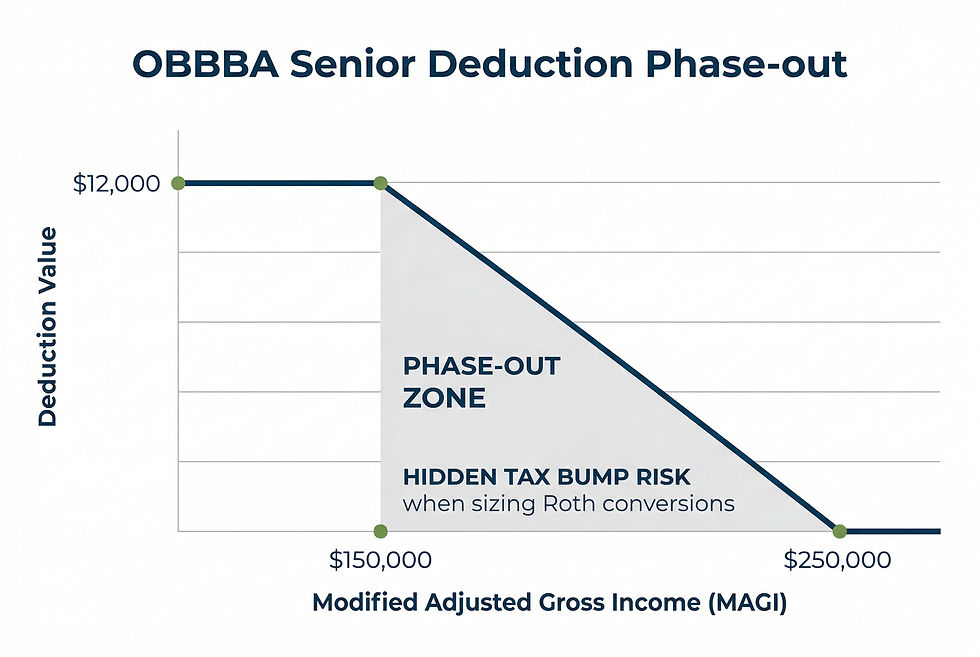
The planning question isn't whether you qualify. It's whether you can manage your income to preserve part of it — especially during the years before RMDs begin, when retirement account withdrawals can push you into higher tax brackets.
What Your Roth Conversion Does to Your Senior Deduction
Here's the connection many advisors aren't making: every dollar you convert from a traditional IRA to a Roth counts as ordinary income. That income pushes you closer to — or through — the senior deduction phase-out.
Convert $80,000 in a year when your other income is $120,000, and your MAGI hits $200,000. You've just lost $6,000 of your senior deduction as a couple (6 cents × $50,000 over the $150,000 threshold times two for both spouses).
That $6,000 in lost deductions costs you roughly $1,320–$1,440 in extra tax, depending on your bracket.
That doesn't mean you shouldn't convert. It means you need to size your conversion differently in 2026 than you would have in 2024.
This is the section to forward to your CPA — or use it as a starting point for questions to ask your financial advisor about your tax plan.
Forward this to your CPA and ask: "Are we modeling the senior deduction phase-out when we size my Roth conversion this year?" If the answer is no, you're leaving money on the table.
The best window for Roth conversions is the "retirement income valley" — the years between when you stop working and when RMDs kick in at age 73. During this window, your income is typically at its lowest.
You can fill up the 10% and 12% brackets with conversions at bargain tax rates. If you're wondering whether that applies to you, start by understanding when a Roth conversion makes sense in the context of your broader retirement plan.
The 2026 12% bracket covers taxable income up to $100,800 (MFJ). After deducting $47,500, a couple could have gross income up to roughly $148,300 and still stay in the 12% bracket — right below the senior deduction phase-out floor.
That's not a coincidence. That's a planning target.
The Harrisons' first advisor told them to "convert as much as possible while rates are low." Generic advice. It ignores the senior deduction phase-out, and it doesn't account for how a large conversion can trigger higher Medicare premiums two years later.
The right amount to convert depends on where the phase-out begins, what bracket you're filling, and what downstream costs the conversion creates. Learn more about how to pay taxes on Roth conversions without undermining your strategy.
The Myth: "I Missed My Roth Conversion Window"
You've probably heard it: "The Tax Cuts and Jobs Act (TCJA) was set to expire in 2025, so if you didn't convert by then, you missed your chance."
It sounds reasonable. For years, financial media warned that tax rates would jump in 2026 when the Tax Cuts and Jobs Act expired. Millions of retirees rushed to convert. Others froze, unsure what to do.
Here's the truth: the OBBBA made the TCJA's tax rates permanent. The 10/12/22/24/32/35/37% bracket structure isn't going away. The "convert before the sunset" urgency is gone.
But a new urgency replaced it. The OBBBA senior deduction expires after 2028. That gives you three tax years (2026, 2027, 2028) where the interaction between conversions and the senior deduction phase-out creates a unique planning opportunity — or a costly trap, depending on whether you're paying attention.
The cost of believing the myth? If the Harrisons assumed they "missed the window" and stopped converting, they'd enter RMD age with $2.8 million still in traditional IRAs.
At 73, their first RMD alone could exceed $100,000 — locking them into the 22% or 24% bracket for the rest of their lives. Over 20 years, that's roughly $142,000 more in taxes than if they'd converted strategically during the valley.
Why QCDs Just Became the Smartest Tax Move in Your Toolkit
If you are over 70 ½ years old, a Qualified Charitable Distribution (QCD) lets you send money directly from your IRA to a qualified charity — up to $111,000 per person in 2026 ($222,000 for married couples).
The transfer satisfies your RMD and never shows up as taxable income. QCDs have been available for years. What changed in 2026 is that the OBBBA made traditional charitable deductions less valuable — while leaving QCDs untouched.
Here's why that matters. Starting in 2026, itemized charitable deductions are subject to a new 0.5% of AGI floor. If your adjusted gross income is $400,000, only donations above $2,000 generate a deduction.
On top of that, the tax benefit of all itemized deductions is now capped at 35 cents on the dollar for taxpayers in the 37% bracket.
QCDs bypass both limitations entirely. They're not deductions — they're income exclusions. That means they reduce your adjusted gross income directly, which can help preserve your senior deduction and keep your Medicare premiums lower.
If you're not yet using them, it helps to review what QCDs are and why they matter before your next round of charitable giving.
If you're 70½ or older and give to charity, QCDs now deliver three benefits regular donations can't match: lower AGI, satisfied RMDs, and no exposure to the new deduction limits.
If you tithe or donate regularly, explore tax reduction strategies for higher-income retirees and broader tax-efficient charitable giving strategies in retirement to see how QCDs fit into your overall plan.
The Harrisons' Plan: What Changes When the Math Is Done Right
After sitting down with a planning team, the Harrisons built a year-by-year withdrawal strategy. They focused on coordinating IRA withdrawal strategies with their tax brackets and deductions.
Instead of waiting until 73, they began measured Roth conversions — filling the 12% bracket each year while keeping income below the $150,000 senior deduction phase-out threshold.
They directed $30,000 per year in QCDs from Linda's IRA to their church and two local nonprofits — reducing their AGI and reducing future RMD amounts before they even begin.
By age 73, they had moved roughly $450,000 into Roth accounts at an average effective rate under 14%. Their remaining traditional IRA balance — now closer to $2.1 million — generated smaller RMDs that stayed in the 22% bracket instead of spilling into the 24%. The result: an estimated $142,000 in lifetime tax savings, plus tax-free growth in the Roth for their heirs.

The strategy only works if the math is right. Convert too much, and you trigger the senior deduction phase-out, push into a higher bracket, or spike your Medicare premiums two years later.
Convert too little, and you're stuck with oversized RMDs for life. The numbers have to be modeled — not guessed. And for retirees with $3 million or more, the stakes are even higher because larger balances generate larger forced distributions — especially under sweeping changes from the One Big Beautiful Bill and its 2025–2028 rules for retirees.
⚠️ COST OF INACTION: $142,000 figure is a hypothetical illustration derived from the difference between an average 14% effective conversion rate and a 24% effective RMD rate on ~$450K over 25 years, plus lost senior deduction value. Individual results depend on actual income, tax rates, and investment returns.
Check This Now: Your 5-Minute Tax Assessment
Here's what you can check right now — before you talk to anyone.
Find your 2025 MAGI. Pull your 2025 Form 1040, Line 11. If it's above $150,000 (MFJ), you may already be in the senior deduction phase-out zone for 2026.
Check your traditional IRA balance. Log into your custodian's website. Divide the balance by 26.5 (the IRS Uniform Lifetime Table divisor for age 73). That's your approximate first-year RMD. Is it larger than you expected?
Look at your current tax bracket. Compare your 2025 taxable income (1040, Line 15) to the 2026 brackets. How much room do you have before hitting the next bracket? That room is your potential conversion space.
Count your charitable giving. Add up what you donated last year. If it exceeds $5,000 and you're 70½ or older, QCDs could save you thousands annually compared to traditional deductions under the new OBBBA rules.
Check whether you're in the "valley." Are you between retirement and age 73? If yes, this is your lowest-income window — and the best time to act.
If even one of those checks surprised you, it's time to model the full picture — ideally with a professional who specializes in retirement tax planning strategies rather than just annual tax preparation.
Not Sure If You're Making the Right Retirement Decisions?
Schedule a free Strategy Session to discuss your situation and get honest answers.
What's keeping you up at night about retirement
How we approach tax planning, income, and investments differently
Whether we're the right fit—or if you're better off on your own
No pressure. No obligation. Just an honest conversation.
Frequently Asked Questions
Why is Reducing Taxable Income Important in Retirement?
Every dollar of taxable income affects more than your tax bracket. In retirement, higher income can increase Medicare premiums, reduce new tax deductions like the OBBBA senior deduction, and accelerate the taxation of Social Security benefits.
Managing your taxable income is how you keep more of the money you've already saved.
What Are the Most Effective Strategies for Reducing Taxable Income in Retirement?
The three most impactful strategies for 2026 are:
(1) Roth conversions during low-income years to shift money into tax-free accounts,
(2) Qualified Charitable Distributions that reduce adjusted gross income by up to $111,000 per person (Fidelity), and
(3) maximizing the 2026 deduction stack of $47,500 for married couples 65+ while the OBBBA senior deduction is still available.
How Does a Roth Conversion Help Reduce Future Taxable Income?
A Roth conversion moves money from a traditional IRA — where withdrawals are taxed as ordinary income — into a Roth IRA, where qualified withdrawals are tax-free. You pay tax on the converted amount now, but you permanently remove that money from future RMDs and taxable income.
Over 20+ years of retirement, this can significantly lower your lifetime tax bill. The key is converting in years when your tax rate is lowest, such as the years between retirement and age 73.
When Should I Start Planning to Reduce My Taxable Income in Retirement?
The earlier the better, but the most critical window is the "retirement income valley" — the years between when you stop working and age 73, when RMDs begin.
During this period, your income is typically at its lowest, which means you can convert IRA funds at lower tax rates and make strategic charitable distributions.
Once RMDs start, your flexibility shrinks. For the 2026–2028 tax years specifically, the temporary OBBBA senior deduction adds extra urgency.

Can I Still Reduce My Taxable Income Through Charitable Giving if I Don't Itemize?
Yes. If you're 70½ or older, QCDs let you send up to $111,000 (2026) directly from your IRA to charity. It doesn't matter whether you itemize — QCDs are income exclusions, not deductions.
They reduce your AGI directly. For 2026, non-itemizers also get a new $2,000 above-the-line deduction for cash donations to charity (MFJ) — though the QCD benefit is far larger for those who qualify.
What is the OBBBA Senior Deduction, and Do I Qualify?
The One Big Beautiful Bill Act created a new $6,000 deduction ($12,000 for married couples filing jointly if both spouses are 65+) available for tax years 2025 through 2028. It's available to both itemizers and standard-deduction filers.
However, it phases out starting at $150,000 MAGI for joint filers and is fully gone at $250,000. You need a valid Social Security number and cannot file as Married Filing Separately.
Ready to get the help you need to retire with peace of mind?
Contact us today for a Free Strategy Session.

About the author:
Financial Advisor
Megan Waters is a CERTIFIED FINANCIAL PLANNER™ professional and Financial Advisor at Covenant Wealth Advisors. Megan has over 14 years of experience in the financial services industry.
Raised in Williamsburg, VA, Megan graduated from the Honors College at the College of Charleston with a BS in Economics and a minor in Environmental Studies.
Disclosures: Covenant Wealth Advisors is a registered investment advisor with offices in Richmond, Reston, and Williamsburg, VA. Registration of an investment advisor does not imply a certain level of skill or training. Past performance is no guarantee of future returns. Investing involves risk and possible loss of principal capital. The views and opinions expressed in this content are as of the date of the posting, are subject to change based on market and other conditions. This content contains certain statements that may be deemed forward-looking statements. Please note that any such statements are not guarantees of any future performance and actual results or developments may differ materially from those projected. Please note that nothing in this content should be construed as an offer to sell or the solicitation of an offer to purchase an interest in any security or separate account. Nothing is intended to be, and you should not consider anything to be, investment, accounting, tax, or legal advice. If you would like accounting, tax, or legal advice, you should consult with your own accountants or attorneys regarding your individual circumstances and needs. This article was written and edited by a CERTIFIED FINANCIAL PLANNER™ professional with the assistance of AI. No advice may be rendered by Covenant Wealth Advisors unless a client service agreement is in place. Hypothetical examples are fictitious and are only used to illustrate a specific point of view. Diversification does not guarantee against risk of loss. While this guide attempts to be as comprehensive as possible, no article can cover all aspects of retirement planning. Be sure to consult an advisor for comprehensive advice.


