
What Are QCDs and Why Do They Matter?

Updated: Aug 29
Many people take their required IRA withdrawal, pay the tax, and write a check to charity. That is ordinary giving. It is not a qualified charitable distribution.
A QCD is a gift sent straight from an IRA to a qualified charity. The dollars never land on Form 1040. That is an exclusion, not a deduction. You do not have to itemize. You cannot claim both on the same gift.

Give because the work matters. The tax result comes second. For 2026, if you already give and you are 70½ or older, the cleaner path is to have the IRA custodian send the gift to the charity.
Say a 74-year-old needed a $22,000 required minimum from a traditional IRA in 2026. He took it in March so he would not forget. In December he wants that $22,000 to be the gift. It cannot. The March withdrawal is already the RMD. A later trustee-to-charity transfer can still be a QCD. It cannot unwind the tax on dollars he already took.
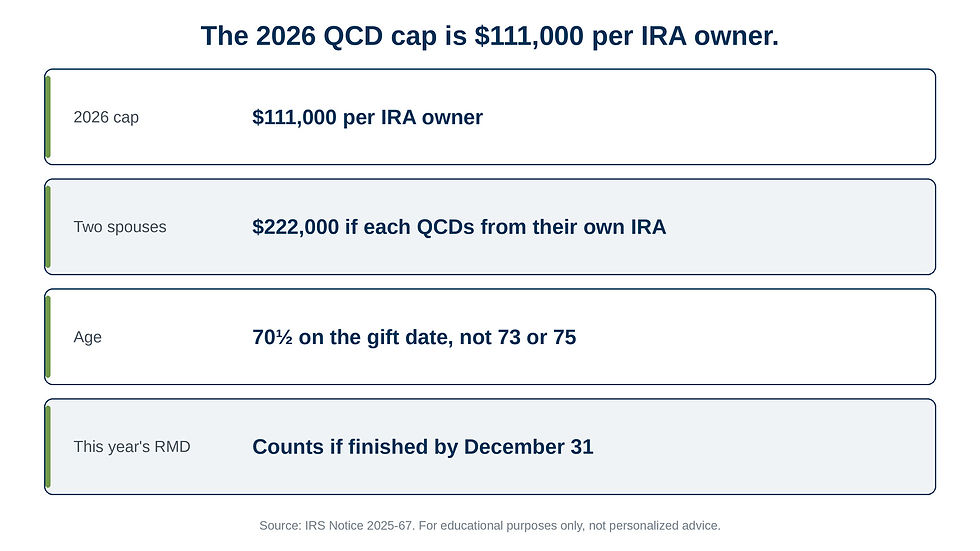
Per person the 2026 cap is $111,000. Eligibility age is still 70½ on the date of the gift, not RMD age 73 or 75. The transfer can count toward that year's RMD if finished by December 31. Donor-advised funds, private non operating foundations, and supporting organizations remain ineligible. One lifetime $55,000 gift to a charitable gift annuity or charitable remainder trust sits inside the $111,000.
The short answer
If you already give, and you are 70½ or older, a QCD lets the IRA send the gift so the dollars never become income. For 2026 the cap is $111,000 per IRA owner (IRS Notice 2025-67). Two spouses, each 70½ or older, each giving from an IRA each owns, can reach $222,000 on a joint return. The check written after a cash withdrawal is ordinary giving. One path is an exclusion. The other is income first, then a deduction.
Key takeaways:
The 2026 cap is $111,000 per person. The joint figure of $222,000 exists only when each spouse QCDs from that spouse's own IRA.
Age is 70½ on the gift date, not the RMD ages of 73 or 75.
The transfer can satisfy that year's required minimum distribution if it is finished by December 31.
Donor-advised funds, private non operating foundations, and supporting organizations remain ineligible.
One lifetime $55,000 election to a charitable gift annuity or charitable remainder trust sits inside the $111,000, not on top of it.
A cash RMD already paid to the owner cannot be relabeled. A later trustee-to-charity transfer can still be a QCD. It cannot reverse tax on dollars already taken.
2026 item | Rule |
|---|---|
Annual cap | $111,000 per IRA owner (Notice 2025-67) |
Joint household | $222,000 only if each spouse QCDs from that spouse's own IRA |
Eligibility age | 70½ on the date of the gift, not RMD age 73 or 75 |
Counts toward the RMD? | Yes, dollar for dollar, if finished by December 31 |
Still banned | Donor-advised funds, private nonoperating foundations, supporting organizations |
One lifetime election | $55,000 to a CGA or CRT, inside the $111,000 |
What are Qualified Charitable Distributions?
Most households that give already have a habit: take money out of the IRA, pay the tax, write a check. That habit feels like the same gift. It is not. The check is income first, then a deduction if you itemize. A QCD never becomes income.
The tradeoff is simple. You give up the chance to hold the cash for a month. You keep the gift out of adjusted gross income (AGI). Standard-deduction households collect almost no federal benefit on the check path, only the small 2026 above-the-line cash gift ($1,000, or $2,000 married filing jointly), which does not cut AGI the way a QCD does. Items that key off AGI (taxable Social Security and Medicare's income-related monthly adjustment amount, or IRMAA) move only when the dollars never arrived.
IRA, 401(k), and pension withdrawals are still ordinary income in 2026, taxed in the 10% to 37% stack, unless they leave as a QCD. The source map is Retirement Income Taxes: How Each Source Is Taxed in 2026. This page is the exception.
The transfer is not a deduction. You do not have to itemize. Taking both on the same gift is a double dip. IRC §408(d)(8)(E) is the bar on deducting the excluded amount. Other gifts in the same year can still go on Schedule A. Those gifts, not the QCD, face the 2026 itemizer rules.
Which account can send the gift? A traditional IRA, an inherited IRA, and an inactive SEP or SIMPLE IRA. A 401(k) or 403(b) is not an IRA, so the balance has to roll to an IRA first. A mid-year rollover does not satisfy the plan's RMD for that year. That RMD generally has to come out of the plan first. Employer money in the year of the gift makes a SEP or SIMPLE "ongoing," and those accounts are ineligible.
Form allows a Roth IRA. Substance usually does not. The exclusion reaches only the portion that would otherwise be includible in income. A qualified Roth withdrawal is already not includible, so the exclusion is usually $0. A traditional IRA is the account that actually produces one.
What are the QCD rules?
The check has to be payable to the charity, not to you. If the money lands in your account first, the gift is ordinary giving. Wiring, a trustee check mailed to the charity, or a check payable to the charity and handed to you for delivery all satisfy the "made directly by the trustee" test (Notice 2007-7 Q-41; IRS information letter 2016-0033). Arrival at your house is fine if the payee is the charity. Your name on the payee line is not.

Age is the next household question. 70½ has to have already arrived on the day of the gift (IRC §408(d)(8)(B)(ii); Pub 590-B). People born 1951-1959 begin RMDs at 73. People born 1960 or later begin at 75. Those clocks are not the QCD clock. SECURE 2.0 raised the RMD age and left the 70½ gate alone. Waiting until 73 is a planning choice, not a legal gate. A QCD at 70½, before any RMD is due, still reduces the IRA and the later minimums.
The 2026 cap is $111,000 per IRA owner (Notice 2025-67). Both spouses 70½ or older, each gifting from an IRA each owns, produces $222,000 on a joint return. Unused room does not migrate. A spouse cannot QCD from the other spouse's IRA. Community-property ownership does not rewrite that rule (IRC §408(g)). Starting in 2024, SECURE 2.0 §307 / IRC §408(d)(8)(G) indexes the cap and rounds to the nearest $1,000. The path: $100k (through 2023) to $105k (2024) to $108k (2025) to $111k (2026). Later years will move.
If you want the gift to count as this year's RMD, finish it by December 31. Dollar for dollar (Pub 590-B; Treas. Reg. §1.408-8(g)(1); Notice 2007-7 Q-42). Until that year's number is met, the first dollars out of the IRA are treated as the RMD (Treas. Reg. §1.408-8(b)(3)). A cash RMD already paid to the owner cannot be relabeled. No recharacterization election exists. Age, donee, and cap permitting, a later trustee-to-charity transfer can still be a QCD and can still cover any remaining unsatisfied RMD. Tax on the dollars already taken does not reverse. Amounts above this year's RMD do not credit next year and do not satisfy next year's RMD.
April 15 is not a QCD deadline. The distribution has to be made during the taxable year. Many tax advisers treat a same-calendar-year receipt as the conservative reading, because IRS guidance has not settled whether a December 31 check deposited in January was "made" in the earlier year.
The charities that fail are the ones households often use for other gifts: donor-advised funds (§4966(d)(2)), private nonoperating foundations, and supporting organizations (§509(a)(3)). A designated or field-of-interest fund at a community foundation can be a §170(b)(1)(A) public charity. A donor-advised fund at the same sponsor is still a donor-advised fund. Confirm the fund type. The sponsor's 501(c)(3) letter does not decide it.
One lifetime election exists: up to $55,000 in 2026 to a CGA, charitable remainder unitrust, or charitable remainder annuity trust, funded exclusively by QCDs (IRC §408(d)(8)(F), added by SECURE 2.0 §307). No sunset. The $55,000 lives inside the $111,000. A $55,000 CGA leaves $56,000 of regular QCD room that year. Using any of the election, even in part, uses it up. Regular annual QCDs cannot fund a CRT or CGA outside that election.
If the IRA is inherited, the beneficiary (not the decedent) must be 70½ on the gift date (Notice 2007-7 Q-37). Own IRAs and inherited IRAs share one $111,000 cap. That inherited account's annual RMD can be satisfied by the gift. An inherited Roth is allowed in form and is usually a waste (already tax-free). An inherited 401(k) has to roll to an inherited IRA first.
Tickets, a dinner, or membership benefits inside the gift fail the entire QCD (IRC §408(d)(8)(C)). Keep the contemporaneous written acknowledgment under §170(f)(8). The receipt does not have to say "QCD." The exclusion is claimed on the 1040.
Deductible IRA contributions after 70½ shrink the excludable amount, and the haircut carries forward (Pub 590-B QCD Adjustment Worksheet). Contribution age no longer has a ceiling. Later QCD room is what shrinks.
Form 1099-R from the custodian shows the full amount (Code 7 on a normal IRA, Code 4 on a death distribution). Code Y exists and, for 2026, is optional. Code Y does not decide the exclusion. On Form 1040 the taxpayer reports the total on 4a, the taxable piece on 4b, and checks the QCD box. Keep the charity letter.
Age, account type, and donee rules sit on one page in the existing flowchart: Can I Do a Qualified Charitable Distribution?.
The next step is personal. Talk with your tax adviser before you instruct the custodian.
How does a QCD change what shows up on the return?
The return looks different because AGI never saw the gift. That is the whole point. Even for someone who itemizes, a QCD and a check-plus-deduction are not substitutes.
Starting in 2026, Schedule A charitable deductions face a 0.5% of AGI floor. A deduction appears only for gifts above that floor. Itemized-deduction benefit is also haircut by 2/37 (commonly described as 35 cents on the dollar in the 37% bracket). Both of those rules miss a QCD, because a QCD is an exclusion. The small nonitemizer cash gift ($1,000, or $2,000 married filing jointly) lives in a different Code section and does not cut AGI the way a QCD does. The 2026 itemizer contrast is in How to Reduce Taxable Income in Retirement.
Dollars that never entered AGI also never enter the Social Security combined-income stack (IRC §86) or IRMAA MAGI (AGI plus tax-exempt interest). 2026 IRMAA can add $81.20 to $487.00 a month on Part B and $14.50 to $91.00 a month on Part D, per person. The first cliff is $109,000 single / $218,000 married filing jointly (CMS, November 14, 2025). MAGI from two years earlier is generally what sets the premium. The worksheet is How Much of Your Social Security Is Taxed in 2026. The surcharge mechanics are How High-Net-Worth Retirees Can Prepare For Medicare IRMAA.
A same-year Roth conversion is a different pile of income. The conversion stays fully ordinary. Dollars already headed to charity are often a poor first candidate to convert in the same year, because the conversion stays fully ordinary. That is a general mechanic, not a recommendation about your conversion. Conversion sizing is a different article: Roth Conversion Strategy: How Much Should You Convert, and When.
If this year's RMD is already larger than the cap, the first $111,000 can still leave as a QCD ($222,000 if both spouses qualify from their own IRAs). Leftover IRA dollars are ordinary income. The $55,000 CGA/CRT election does not create extra room for that leftover. Appreciated stock from a taxable account, including into a donor-advised fund, is a different overflow tool, and it now faces the 0.5% floor. Several public charities in one year are fine. The cap is still one cap. Residual IRA dollars can pass to charity at death by beneficiary designation. After RMDs begin, a QCD is one Code-level way those first dollars can stay out of AGI. Whether it belongs in a given year is a question for your tax adviser: How Can I Lower My Taxable Income Once I Start Taking RMDs?
Say a 73-year-old has a $1,000,000 traditional IRA. The Uniform Lifetime age-73 factor is 26.5. The required minimum is $37,736, still under $111,000. One-owner overflow begins around $2,941,500 ($111,000 × 26.5). The same factor on a $5,000,000 IRA produces $188,679, so $77,679 remains ordinary after a $111,000 QCD. Invented balances, not a recommendation to give any of those amounts.

Unused cap does not carry, so a large gift can be spread across years. Work the calendar with your tax adviser.
Frequently asked questions
I already took my RMD and wrote a check. Can I call that a QCD?
No. The cash withdrawal is already the RMD. A later trustee-to-charity transfer can still be a QCD. It cannot unwind the tax on dollars already taken.
Is the age 70½ or 73?
70½ on the date of the gift. People born 1951-1959 begin RMDs at 73. People born 1960 or later begin at 75. Those clocks are not the QCD clock.
Can a married couple QCD $222,000 from one spouse's IRA?
No. Each spouse has to give from an IRA that spouse owns. Unused room does not migrate.
Can I send a QCD to a donor-advised fund?
No. Donor-advised funds, private nonoperating foundations, and supporting organizations remain ineligible.
Does Code Y on Form 1099-R prove the gift is a QCD?
No. Code Y exists and, for 2026, is optional. The taxpayer still reports the total on Form 1040 line 4a, the taxable piece on 4b, and checks the QCD box.
Can an inherited IRA fund a QCD?
Yes, if the beneficiary (not the decedent) is 70½ on the gift date. Own IRAs and inherited IRAs share one $111,000 cap.
The bottom line
Give because the work matters. If the gift is going to leave an IRA in 2026, send it straight to a qualified charity, at 70½ or older, by December 31 if you want it to count as this year's RMD. The check written after a cash withdrawal is ordinary giving. Talk with your tax adviser before you instruct the custodian.
If you want an educational conversation about how the 2026 QCD rules sit next to IRA withdrawals and RMDs, book a free Retirement Strategy Session. It is a 45-60 minute introductory conversation for households that may be a fit (generally $1 million or more invested, excluding real estate). Not a plan. Not advice. No advisory relationship from a click or from the session. Advice comes only after a client service agreement.

About the author:
CEO and Senior Financial Advisor
Mark is the CEO of Covenant Wealth Advisors and a Senior Financial Advisor helping individuals age 50+ plan, invest, and enjoy retirement comfortably. Forbes nominated Mark as a Best-In-State Wealth Advisor* and he has been featured in the New York Times, Barron's, Forbes, and Kiplinger Magazine.
This article was written and edited by a CERTIFIED FINANCIAL PLANNER™ professional with the assistance of AI.
Covenant Wealth Advisors is a DBA of Fonville Wealth Management, LLC, an SEC-registered investment adviser. Registration with the SEC does not imply a certain level of skill or training. Offices in Richmond, Williamsburg, and Reston, Virginia. Clients nationwide.
This article is for general education only. It is not investment, tax, legal, or personalized financial advice, and it is not a recommendation to complete or skip a qualified charitable distribution, to take or avoid an IRA withdrawal, to complete or avoid a Roth conversion, or to carry out any other transaction. Covenant Wealth Advisors provides investment advice only after a client service agreement is in place. If you are not a client, nothing in this article is advice for you. Consult your own tax and legal advisers about your situation.
Investing involves risk, including possible loss of principal. Past performance is not indicative of future results. Nothing here is an offer or solicitation to buy or sell any security.
Figures in this article, including the $1 million and $5 million IRA examples and the Uniform Lifetime age-73 factor of 26.5, are labeled hypotheticals. They use IRS Publication 590-B (2025) Appendix B Table III and the assumptions stated in the article (invented balances; statutory QCD and RMD rules). They are not client results, not a projection of any household's tax, and not a guarantee. Your tax, RMD, IRMAA, and filing status will differ.
A free Retirement Strategy Session is a 45–60 minute educational conversation. It is not a financial plan and not advice. No advisory relationship is formed by booking or attending. Advice is provided only after a client service agreement is in place. The session is generally for households with $1 million or more invested, excluding real estate.
CFP® and CERTIFIED FINANCIAL PLANNER™ are certification marks owned by Certified Financial Planner Board of Standards, Inc. Those marks are awarded to individuals who successfully complete CFP Board's initial and ongoing certification requirements.
Full legal disclosure: https://covenantwealthadvisors.com/legal-disclosure


