
How to Pay Taxes on Roth IRA Conversions (2026 Guide)

Updated: 6 days ago
If you're converting part of your IRA this year, the next question is how to pay taxes on a Roth conversion without shrinking it or triggering an IRS penalty. On a $150,000 conversion, leaving the custodian's default 10% withholding in place sends $15,000 to the IRS instead of your Roth. The size of the conversion matters too, because it can change what Medicare charges you in 2028.
Quick answer: You can pay Roth conversion taxes with cash sent to the IRS as estimated payments, with extra withholding from wages, a pension, Social Security or an IRA distribution, or by withholding from the conversion itself. Tax on a 2026 conversion is due by April 15, 2027, but you may owe a penalty unless your 2026 payments meet an IRS safe harbor.

Key takeaways
Paying the tax with cash from outside the IRA keeps the full conversion in the Roth, where it can grow tax-free.
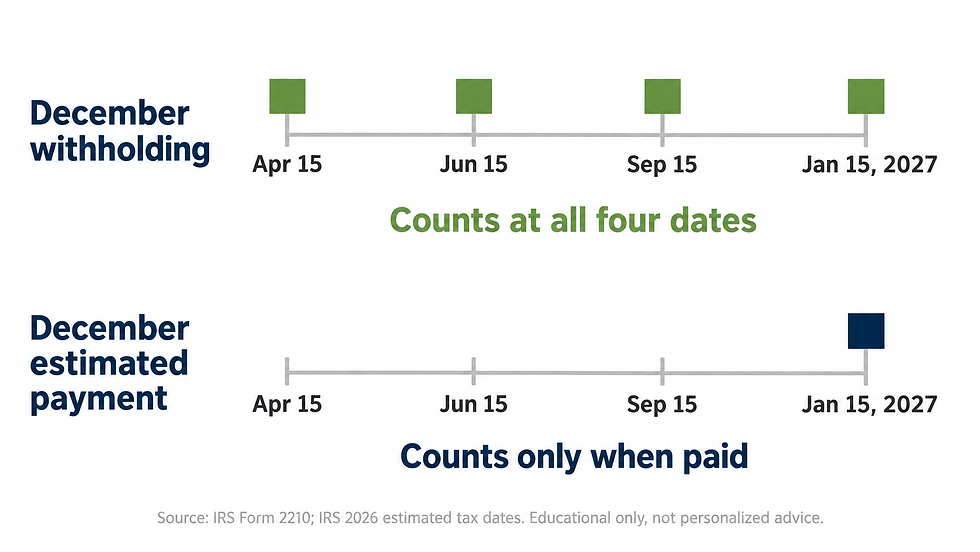
The IRS treats federal withholding as paid evenly through the year, even when it happens in December. Estimated payments count only from the day they're paid.
You generally avoid the underpayment penalty if 2026 payments cover the smaller of 90% of your 2026 tax or 100% of your 2025 tax (110% if your 2025 AGI topped $150,000).
If you're under 59½, tax withheld from a conversion is an early distribution and can owe the 10% additional tax.
Conversion income in 2026 sets your 2028 Medicare premiums and can phase out the new $6,000 senior deduction.
How do you pay taxes on a Roth conversion?
You can pay with cash from outside the IRA, with extra withholding from income you already receive, with withholding from an IRA distribution you're taking anyway, or with withholding from the conversion itself. Paying taxes on a Roth conversion from outside the IRA usually costs the least, because every converted dollar stays in the Roth.
Where the tax money comes from | When the IRS counts it as paid | What reaches the Roth |
Cash from savings or a taxable account, sent as estimated payments (IRS Direct Pay, EFTPS or your IRS Online Account) | The day you pay | The full conversion |
Extra withholding from wages, a pension or Social Security | Spread evenly over the year | The full conversion |
Withholding from an IRA distribution you'd take anyway, such as your RMD | Spread evenly over the year | The full conversion, but the IRA shrinks by the withheld amount |
Withholding from the conversion itself | Spread evenly over the year | The conversion minus the withheld amount |
The middle column matters more than it looks. Federal tax that's withheld is treated as paid in equal pieces on each quarterly due date, no matter when it actually came out of your account (IRS Form 2210). An estimated payment, by contrast, only counts from the day the IRS receives it.

In our planning work, the default order runs from cash outside the IRA, to withholding from income you already receive, to withholding from the conversion as the last resort. Which account you draw from in a given year is its own decision, and our guide to IRA withdrawal strategies covers that sequencing. That order can flip. If raising the cash means selling investments with large gains, the capital gains tax and the extra income both need pricing before you decide.
Conversion pitches tend to stop at the word "convert." The payment plan, which decides how much of the benefit you keep, usually gets left for April.
If you hold enough cash outside the IRA to cover the bill and still keep your emergency reserve, use it. If you don't, read the withholding section below before you settle for a smaller conversion.
Do you have to pay taxes immediately on a Roth conversion?
No. Tax on a 2026 Roth conversion is part of your 2026 income tax, and the return and final payment are due April 15, 2027. The catch is that the IRS runs a pay-as-you-go system, so waiting until April can cost you an underpayment penalty.
You generally need to make estimated payments during the year if you expect to owe $1,000 or more after withholding (IRS estimated tax FAQ), and a large conversion clears that bar easily.
One thing can happen right away without your asking. IRA distributions, including conversions, are subject to federal withholding unless you opt out (IRS Topic 557). The default rate on a one-time distribution is 10% unless you choose a different rate on Form W-4R. Read the withholding section of the conversion form carefully, since some custodians handle the election online while others need a phone call or a paper form.
If you want the full amount in the Roth, elect 0% withholding and plan the payment separately. Leave the default in place and 10% of the conversion goes to the IRS instead.
How do you avoid an underpayment penalty on Roth conversion taxes?
Meet a safe harbor. You generally won't owe the penalty if your 2026 withholding and on-time estimated payments cover the smaller of 90% of your 2026 tax or 100% of your 2025 tax. That second figure rises to 110% if your 2025 AGI was over $150,000, or $75,000 if married filing separately (IRS).
The prior-year option is the predictable one. It doesn't care how large this year's conversion turns out to be, which makes it the natural anchor for a household converting in stages.
Estimated payments for 2026 are due on four dates:
April 15, 2026
June 15, 2026
September 15, 2026
January 15, 2027
Here's the rule that does most of the work. Withholding counts as paid evenly across those four dates even if all of it happens in December, while a check sent in December only covers December. So late-year withholding can repair an earlier shortfall, and a late estimated payment can't.
Missing a payment costs interest rather than a flat fine. For October through December 2026, the IRS charges 7% a year, compounded daily (IRS IR-2026-98).
Converting in the last quarter of 2026
It's October. If you plan to convert before December 31 and haven't made estimated payments, you still have clean options.
Check where you stand. Add up your 2026 withholding and estimated payments so far, then compare the total with 110% (or 100%) of your 2025 total tax.
Close any gap with withholding before December 31. Raise withholding on a paycheck, a pension, or an IRA distribution you're already taking, such as your required minimum distribution.
Pay the rest on time. Send the conversion's remaining tax by January 15, 2027, or by April 15, 2027 if the safe harbor is already met.
Ask about annualizing. If you're still short, Form 2210 Schedule AI lets you show that the income arrived late in the year, which can shrink or erase penalties on the earlier quarters. Have your tax preparer run the calculation.
If your safe harbor is already covered, the conversion's tax can wait until April 15, 2027. If it isn't, December withholding is usually the cleanest fix.
Should you withhold taxes from the Roth conversion itself?
Usually not. Withheld dollars never reach the Roth, so a conversion with 24% withheld moves 76 cents of each dollar instead of the whole dollar. If you're under 59½, the withheld amount counts as an early distribution and can owe the 10% additional tax as well (IRS Topic 557).
Take a $100,000 conversion with 24% withheld. Only $76,000 lands in the Roth, yet you still owe income tax on the full $100,000, and someone under 59½ can owe up to $2,400 more on the $24,000 that was withheld.

Vanguard researchers Boris Wong and Joel Dickson measured this trade-off in 2022 using a break-even tax rate, which is the future rate at which converting and not converting come out even. In their model, paying a 35% conversion tax from inside the IRA set the break-even at 35%. Paying from a tax-efficient taxable account lowered it to 29.6%, and paying from tax-inefficient taxable investments lowered it to 23.5% (Vanguard, 2022).
Those results come from a hypothetical model that assumes a 6% annual return over 20 years. They are not a forecast or a guarantee.
The direction is what matters. Outside money widens the range of future tax rates where a conversion can still come out ahead.
Withholding still has a place. If nearly everything you own sits inside the IRA, a smaller conversion with tax withheld may beat no conversion at all. That depends on two things: your tax rate now compared with later, and how long the money stays invested.
There's also a middle path. You elect withholding on the conversion, then deposit the same amount of outside cash into the Roth within 60 days. The IRS says a rollover must use other funds to make up for any amount withheld (IRS), and the once-a-year rollover limit doesn't apply to conversions.
That combination gives you withholding's timing along with a full conversion. Set it up with your custodian and tax preparer before you start, because a missed 60-day window can't be fixed afterward.
If you have the cash outside, elect 0% withholding. If you don't, size the conversion to what you can afford to have withheld, and don't let the 10% default make the decision for you.
How much tax will a Roth conversion cost in 2026?
The converted amount is taxed as ordinary income at your 2026 rates. For a married couple filing jointly, the 22% bracket runs to $211,400 of taxable income and the 24% bracket runs to $403,550 (IRS Rev. Proc. 2025-32). The One Big Beautiful Bill Act made these rates permanent in July 2025.
2026 federal brackets, married filing jointly
Rate | Taxable income | Total tax at top of bracket |
10% | $0 – $24,800 | $2,480 |
12% | $24,801 – $100,800 | $11,600 |
22% | $100,801 – $211,400 | $35,932 |
24% | $211,401 – $403,550 | $82,048 |
32% | $403,551 – $512,450 | $116,896 |
35% | $512,451 – $768,700 | $206,583.50 |
37% | Over $768,700 | — |
Source: IRS Rev. Proc. 2025-32. Single filers: 22% to $105,700, 24% to $201,775.
The 2026 standard deduction for joint filers is $32,200, plus another $1,650 for each spouse who is 65 or older.
The bigger change sits outside the table. The same law added a $6,000 deduction for each person 65 or older for 2025 through 2028 (IRS FS-2025-03). It shrinks by 6% of MAGI above $150,000 on a joint return ($75,000 single), and it disappears entirely by $250,000 ($175,000 single) (IRS Schedule 1-A, Part V).
Conversion income raises MAGI, so it can quietly consume that deduction. For a couple who are both 65 or older, each conversion dollar between $150,000 and $250,000 of MAGI removes 12 cents of deduction, or 6 cents per spouse. Inside the 22% bracket, that turns a 22% rate into roughly 24.6% (22% plus 22% × 12%).

If your conversion lands MAGI between $150,000 and $250,000, estimate the bill at 24.6% rather than 22%. The deduction is scheduled to end after 2028.
A worked example: paying the tax on a $198,000 conversion (hypothetical)
Hypothetical example for illustration only. These are not real clients, and your numbers will differ.
Picture a married couple, both 66 and retired, who hold $1.6 million in traditional IRAs and $700,000 in a taxable brokerage account. They're delaying Social Security until 70, and their only other 2026 income is $20,000 of taxable interest. Because they also converted in 2025, their 2025 federal tax bill was $24,000 on AGI above $150,000.
How much they convert. They stop at $218,000 of MAGI, the 2026 joint threshold for Medicare's first income surcharge, which means converting $198,000 in November.
What it costs. Their deductions total $39,340: the $32,200 standard deduction, $3,300 for both being 65 or older, and $3,840 of senior deduction left after the phase-out. Taxable income is $178,660, and federal tax comes to about $28,729 ($11,600 plus 22% of the $77,860 above $100,800). All of that tax comes from the conversion, and it equals 14.5% of the amount converted.
How they pay it. In April they set quarterly estimates at 110% of their 2025 tax, which is $26,400, or $6,600 a quarter, paid from cash in the brokerage account. Those payments meet the safe harbor, so the remaining $2,329 is due April 15, 2027 with no underpayment penalty. All $198,000 stays in the Roth.
Writing five-figure checks for money you won't spend for years can feel backwards. It's the price of tax-free withdrawals later, under current law.
The cost of one more step. Had they converted $199,000, MAGI would reach $219,000. The extra $1,000 adds about $246 of federal tax, and, using 2026 thresholds as a stand-in for 2028, it also puts both spouses in Medicare's first surcharge tier: ($81.20 + $14.50) × 12 months × 2 people = $2,296.80 for the year. It would be the most expensive $1,000 they move all year.

In our planning work with couples in the gap between retirement and Social Security, the sequence looks like this. We project the year's income with the conversion included, measure the room left before the next threshold, and then size the conversion to the room.
What other costs can conversion income trigger?
Conversion income raises your modified adjusted gross income (MAGI), and several costs key off that single number. For most retirees, the two that matter most are Medicare's income surcharge two years later and the share of Social Security that becomes taxable.
Medicare premiums (IRMAA)
Medicare sets your Part B and Part D premiums using your tax return from two years earlier, so a 2026 conversion lands in your 2028 premiums. The surcharge is called IRMAA, and it works in tiers. One dollar over a line moves you into the next tier for the entire year.
2026 IRMAA tiers (based on 2024 income), per person
MAGI, joint return | MAGI, single | Part B surcharge per month | Part D surcharge per month |
$218,000 or less | $109,000 or less | $0 | $0 |
Up to $274,000 | Up to $137,000 | $81.20 | $14.50 |
Up to $342,000 | Up to $171,000 | $202.90 | $37.50 |
Up to $410,000 | Up to $205,000 | $324.60 | $60.40 |
Under $750,000 | Under $500,000 | $446.30 | $83.30 |
$750,000 or more | $500,000 or more | $487.00 | $91.00 |
Source: CMS, 2026 Medicare Parts A & B Premiums and Deductibles. The standard 2026 Part B premium is $202.90 a month. Tiers for 2028 haven't been published.
A voluntary conversion isn't one of the life-changing events listed on Social Security's appeal form, SSA-44. Plan around the tiers instead of counting on an appeal.
Social Security
Up to 85% of your benefits become taxable once combined income passes $44,000 on a joint return or $34,000 for a single filer (SSA). Combined income is your AGI plus nontaxable interest plus half of your benefits, and those thresholds aren't indexed for inflation.
While benefits are still phasing into tax, each conversion dollar can pull up to 85 cents of benefits into taxable income. That's $1.85 of taxable income for every $1 converted.
Other lines to check
Net investment income tax. A 3.8% tax applies to investment income once MAGI tops $250,000 on a joint return or $200,000 single (IRS Topic 559). A conversion isn't investment income, but it raises MAGI.
State and local tax deduction. For itemizers, the 2026 cap of $40,400 shrinks by 30% of MAGI above $505,000, down to a $10,000 floor (Schwab).
Marketplace health coverage before 65. For 2026 coverage, premium subsidies end once household income passes 400% of the federal poverty level (healthinsurance.org).
State income tax. Federal withholding doesn't cover it, so make a separate state election or payment.
If a conversion would land you within a few thousand dollars of any of these lines, run the numbers both ways before you choose the amount.
How do you report a Roth conversion on your tax return?
Your custodian sends Form 1099-R early in 2027 for a 2026 conversion. You report the gross amount on Form 1040 line 4a and the taxable part on line 4b, and if any of your traditional, SEP or SIMPLE IRAs hold after-tax money, you also file Form 8606 (IRS).
Form 8606 applies the pro-rata rule. The tax-free share equals your after-tax basis divided by the year-end value of all those IRAs combined, plus whatever you converted or withdrew during the year. With $500,000 pre-tax and $20,000 of basis, about 3.8% of any conversion is tax-free, whichever account you convert from.
Frequently asked questions
Can I use money from my IRA to pay the tax on a Roth conversion?
Yes. You can have tax withheld from the conversion or from a separate IRA distribution. The withheld amount isn't converted, so less reaches the Roth, and if you're under 59½ it can owe the 10% additional tax on early distributions.
Will my IRA custodian withhold tax automatically?
Often, yes. IRA distributions, including conversions, are subject to federal withholding unless you opt out, and the default for a one-time distribution is 10%. You choose a different rate, including zero, on Form W-4R.
Is there a deadline to do a Roth conversion for 2026?
Yes. The conversion must be completed by December 31, 2026 to count as 2026 income, because a conversion is taxed in the year the money leaves the traditional IRA (IRS Pub. 590-A). Unlike IRA contributions, conversions get no extension into April.
Can I undo a Roth conversion if I can't pay the tax?
No. Conversions made after 2017 can't be recharacterized back to a traditional IRA (IRS). Plan the payment before you convert.
Do I have to take my RMD before converting?
Yes. Once you reach RMD age, which generally begins at 73 under current IRS rules, the year's required distribution must come out first, because RMDs can't be rolled over or converted (IRS). Our guide to RMD tax strategies covers the order in more detail.
Does federal withholding cover state tax on a conversion?
No. State tax needs its own withholding election or estimated payment. If your state has an income tax, check how it treats conversions before you pick an amount.
The bottom line
The conversion decision gets the attention. The payment plan decides how much of it you keep. Use cash from outside the IRA where you can, and let withholding handle the timing when the calendar gets tight. Then size the conversion to the room under the next 2026 line. That room is measured in MAGI, not in tax brackets alone.
If whoever recommended your conversion can't tell you which account pays the tax and on what date, the recommendation isn't finished.
The right amount and the right payment source depend on your own 2026 income, last year's return, and where your next threshold sits. Talking those numbers through for your situation, before December 31, is the natural next step.
Would you like our team to just do your retirement planning for you? Contact us today for a free strategy session.

About the author:
Senior Financial Advisor
Adam is a Senior Financial Advisor with Covenant Wealth Advisors and a CERTIFIED FINANCIAL PLANNER™ practitioner. He has over 17 years of experience in the financial services industry in the areas of financial planning for retirement, tax planning, and investment management.
Disclosures: Covenant Wealth Advisors is a registered investment advisor with offices in Richmond, Reston, and Williamsburg, VA. Registration of an investment advisor does not imply a certain level of skill or training. Past performance is no guarantee of future returns. Investing involves risk and possible loss of principal capital. The views and opinions expressed in this content are as of the date of the posting, are subject to change based on market and other conditions. This content contains certain statements that may be deemed forward-looking statements. Please note that any such statements are not guarantees of any future performance and actual results or developments may differ materially from those projected. Please note that nothing in this content should be construed as an offer to sell or the solicitation of an offer to purchase an interest in any security or separate account. Nothing is intended to be, and you should not consider anything to be, investment, accounting, tax, or legal advice. If you would like accounting, tax, or legal advice, you should consult with your own accountants or attorneys regarding your individual circumstances and needs. This article was written and edited by a CERTIFIED FINANCIAL PLANNER™ professional with the assistance of AI. No advice may be rendered by Covenant Wealth Advisors unless a client service agreement is in place. Hypothetical examples are fictitious and are only used to illustrate a specific point of view. Diversification does not guarantee against risk of loss. While this guide attempts to be as comprehensive as possible but no article can cover all aspects of retirement planning. Be sure to consult an advisor for comprehensive advice.


