
Roth Conversion Strategy: How Much Should You Convert, and When?
- Mark Fonville, CFP®
- Jun 12
- 14 min read
Updated: Jun 19
Quick answer: how much and when?
A Roth conversion is rarely all-or-nothing. The right amount to convert each year is usually the lower of two ceilings — the top of your target federal tax bracket and the next Medicare IRMAA income threshold — minus your other income and deductions.

Disclosure: The scenarios included are hypothetical illustrations used to demonstrate planning concepts. They do not represent the experience of actual clients. Hypothetical financial planning illustrations have inherent limitations, including that they are prepared with the benefit of hindsight and do not reflect actual results of any specific client situation.
The best years are usually the low-income gap between when you retire and when Social Security and required withdrawals begin (IRS RMD Rules).
Key takeaways
Convert up to the lower of your tax-bracket ceiling and the next IRMAA income threshold — not a dollar more.
The best years are usually the gap between retiring and starting Social Security or required withdrawals. Those withdrawals begin at age 73 for people born 1951–1959 and 75 for those born 1960 or later.
IRMAA is a cliff with a two-year lookback — one dollar over a tier can raise both spouses’ Medicare premiums.
Converting while both spouses are alive may defuse the widow’s penalty, where the survivor can jump from the 12% to the 22% bracket on the same income.
Conversions can backfire — a lower future tax rate, paying the tax from the IRA, charitable giving plans, or a short time horizon can all tip the math. The answer depends on your situation.
Want Us to Just Do Your Retirement Planning for You?
In one free 45-minute Strategy Session with a CFP® professional, you'll find out exactly where you stand — and whether we're the right firm to get you the rest of the way.
Walk away with a clear read on your situation and the gaps worth fixing — whether you work with us or not.
See what changes when your investments, taxes, and retirement income are managed as one plan instead of three.
Find out whether we're the right fit to be your advisor — or if you're better off on your own. If we're not, we'll tell you.
No pressure. No obligation. Just an honest conversation.
Fee-only fiduciary serving families with $1M+ in retirement savings across 22+ states.
An overview of Roth Conversion strategy in one minute (and why the playbook changed)
A Roth conversion moves money from a pre-tax account — a traditional IRA or 401(k) — into a Roth IRA. You pay ordinary income tax on the amount you convert this year. In exchange, that money grows and comes out tax-free later, if you follow the rules.
What a conversion is
You shift pre-tax dollars into a Roth. You owe tax this year at your normal income rates. After that, qualified withdrawals are tax-free, and there is no required minimum distribution during the original owner’s lifetime on a Roth IRA (Roth Withdrawal Rules). The no-RMD feature is a real edge.
A traditional IRA forces money out every year once you reach your required age. A Roth does not.
Why “beat the sunset” is dead — and what replaced it
For years, the pitch was urgency: the 2017 tax cuts were set to expire after 2025, so convert before rates jumped. That urgency is gone now. The One Big Beautiful Bill Act (Public Law 119-21, signed July 4, 2025) made the seven-rate tax structure permanent, and the scheduled jump to a 39.6% top rate is canceled (IRS Rev. Proc. 2025-32).
So the case for converting is no longer a ticking clock. It is about beating four things you can see coming:
Your future required minimum distributions (RMDs), which can force large taxable withdrawals later.
Your Medicare IRMAA surcharges, which rise with income.
The tax on your Social Security benefits.
The widow’s penalty — the higher tax a surviving spouse often pays.
Tax law can change again, so treat every figure here as current for 2026 and subject to future legislation.
How much should you convert? The dual-ceiling rule
Here is the question we hear constantly: how much should I convert without creating a new tax problem?
The clean rule has two parts. First, find the lower of two ceilings — the top of your target federal tax bracket and the next IRMAA income threshold.
Then subtract all your other income and deductions. What’s left is your maximum sensible conversion for the year. The two ceilings use different income definitions; for brackets, taxable income is the ticket, and for the IRMAA threshold, what matters is your MAGI figure.
The generic guides we see usually stop at "fill your bracket".

For many households age 63 and older, the second ceiling is the one that actually binds first.
Ceiling 1: Fill your tax bracket
Convert up to the top of your target bracket — and not a dollar into the next one.
Remember to subtract your deductions to find your real room. The 2026 standard deduction is $32,200 for married couples filing jointly and $16,100 for single filers, with an extra age-65 amount of $1,650 per spouse (joint) or $2,050 (single) (IRS Rev. Proc. 2025-32).
There is also a temporary senior “bonus” deduction of up to $6,000 per person age 65 and older (up to $12,000 for a couple). It applies only for tax years 2025 through 2028.
It also phases out above $150,000 of income for couples ($75,000 single) and disappears entirely at $250,000 ($175,000 single) (IRS, One Big Beautiful Bill Act).
Because it sunsets after 2028, treat it as a short-term boost to your conversion room, not a permanent fixture.
Ceiling 2: Stop at the IRMAA cliff
For anyone 63 or older, the binding ceiling is often the next IRMAA income threshold, not the bracket top. IRMAA is the income-related surcharge on Medicare premiums, and we cover its full table in the next section.
The rule to remember: your true conversion ceiling each year is the lower of the bracket top and the next IRMAA threshold, minus your other income and deductions. One detail trips people up.

The income figure that counts for IRMAA is your modified adjusted gross income (MAGI). That is your AGI plus any tax-exempt interest—for example, interest from municipal bonds. People may forget the tax-exempt piece and accidentally cross a tier.
Worked composite examples:
The two examples below are hypothetical composites for illustration only. They are not actual Covenant clients. Figures are rounded, and your results would depend on your own income, deductions, filing status, and the rules in effect.
Example 1 — a Williamsburg, Virginia couple, both 63, with $1.3 million in traditional IRAs. They are retired, not yet on Social Security, and living off a taxable brokerage account.
Their other taxable income is modest. On bracket math alone, they could convert a large amount and still stay inside the 24% bracket (which tops at $403,550 of taxable income for 2026).
But they will be on Medicare in a couple of years, and the two-year lookback means this year’s income sets their future premiums. So the binding ceiling is the next IRMAA threshold, not the bracket top.
In a case like this, the IRMAA ceiling — not the tax bracket — may cap the conversion well below what the bracket alone would allow.
Example 2 — a couple in their early 60s with $3 million-plus in tax-deferred accounts. A balance this size often cannot be converted in a year or two without spilling into high brackets and high IRMAA tiers.
The fiduciary approach is to stage the conversions across multiple gap years. Each year, they convert up to the lower ceiling. That way the household chips away at the future tax-deferred balance without triggering an avoidable surcharge or bracket jump.
The point of staging is to spread the tax over several lower-rate years rather than bunch it into a few high-rate ones. Any growth shown in a projection is hypothetical; past performance is not indicative of future results.
Because Virginia taxes traditional IRA withdrawals and Roth conversions as ordinary income, your state tax matters too. (See our guide on Virginia State Income Tax: Rates and Rules for Residents.) We weave that into the annual math.
When to convert: your gap-year window
The best years to convert are usually the low-income gap between when you retire and when Social Security and required withdrawals begin. In that window you can fill the lower brackets — 10%, 12%, 22%, or 24% — at rates that are historically low.
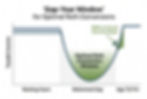
The retirement-to-RMD gap
Required minimum distributions begin at age 73 for those born 1951–1959 and 75 for those born 1960 or later, under the SECURE 2.0 law (Library of Congress).
Your first one is technically due by April 1 of the year after you reach that age. But delaying that first withdrawal stacks two RMDs into one year, which can spike your income. Ages 60 to 62 are the cleanest years; from 63 on, the IRMAA lookback is in play.
A fair question we hear: isn’t the gap exactly when I need my money, so why give some of it to taxes? The answer is sequencing. In those years, you can fund your living expenses from a taxable brokerage account.
That keeps your taxable income low and frees up bracket room for conversions. So you are not really “giving up” spending money. You are just choosing which account it comes from.
Before or after Social Security?
It often helps to convert before you claim Social Security. Once benefits start, adding conversion income on top can pull more of those benefits into being taxed — a stacking effect sometimes called the “tax torpedo.” (Fidelity).
Worth knowing: the income thresholds that decide how much of your Social Security is taxed are not adjusted for inflation.
Up to 50% of benefits can be taxed above $32,000 of combined income for couples ($25,000 single), and up to 85% above $44,000 ($34,000 single) (Is Social Security Taxed).
Converting in a down market
A market dip can be a quiet opportunity. If you convert shares while they are temporarily depressed, the recovery then happens inside the Roth, tax-free.
Spreading conversions across a volatile stretch — sometimes called conversion-cost averaging — can also smooth the tax. This is a timing idea, not a guarantee; markets may not recover on any schedule.
Roth conversions and your Medicare premiums (IRMAA)
A Roth conversion raises your MAGI, and that can trip a Medicare IRMAA surcharge two years later. IRMAA is a cliff, not a gradual phase-in — go one dollar over a tier and the full surcharge applies. And it hits both spouses who are on Medicare.
The two-year lookback
Your 2026 surcharge is based on your 2024 MAGI — your AGI plus tax-exempt interest (CMS; Social Security Administration). The practical takeaway: a conversion you do at 63 can raise your premiums at 65.
Plan around the lookback so you are not blindsided. IRMAA is not a fringe issue, either. About 5.1 million Medicare beneficiaries paid an IRMAA surcharge in 2025 — roughly 7% of enrollees, per the Social Security Administration (reported via Kiplinger).
Is taking the IRMAA hit ever worth it?
Sometimes — it depends on your situation. At the first tier, going one dollar over adds $81.20 a month in Part B (about $974 a year) plus $14.50 a month in Part D (about $174 a year) per person.
A couple both on Medicare can owe about $2,300 a year in combined surcharges (CMS).

That sounds like a clear “stay under.” But if accepting one tier for a year or two lets you convert enough to defuse a much larger RMD-driven tax problem later, the trade can still favor converting.
We model that multi-year tradeoff before deciding, and we work to keep clients off the cliff edge unless crossing it clearly pays off.
The widow’s penalty: why couples should act now
This is the most overlooked reason for couples to convert — and many generic guides skip it entirely. When one spouse dies, the survivor often files as single the very next year. Same income, but a higher bracket and a lower IRMAA threshold.
Vanguard puts the bracket effect plainly. In its paper “A BETR Approach to Roth Conversions,” Vanguard notes that “a couple with a $60,000 annual income falls in the 12% tax bracket, while a widowed single filer with the same income may land in the 22% bracket.” (Vanguard BETR).
That is Vanguard’s illustration, and the “may” matters — the exact result depends on the year’s brackets and the survivor’s situation.

The Medicare side squeezes the survivor too. The single IRMAA threshold ($109,000) is half the joint threshold ($218,000), so a surviving spouse can hit surcharges on far less income (CMS). The result: the survivor often pays more tax on the same money, right when life is already harder.
Consider a hypothetical composite — not an actual client: a married couple in their late 60s, one spouse in noticeably better health than the other. They have a large traditional IRA. Converting together now uses the wider married brackets and the higher joint IRMAA threshold while both spouses are alive.
That shrinks the tax-deferred balance the survivor would otherwise inherit and have to draw down as a single filer.
The move is especially worth weighing for couples with an age gap or a meaningful health difference. The benefit depends on your circumstances and future tax law.
The 5-year rules, explained simply
Two separate five-year clocks confuse almost everyone. Here they are, plainly:
The “forever” clock. Your Roth IRA must be open five years before earnings can come out tax-free. There is one of these per person, set by your very first Roth.
The conversion clock. Each conversion has its own five-year clock. It governs only the 10% penalty on withdrawn converted principal if you take it out before age 59½.

Here is the part many people miss: once you are over 59½ and have had any Roth open for five years or more, both clocks stop mattering for your conversions (IRS Publication 590-B). You also do not need a separate Roth account for each conversion — one Roth IRA holds them all.
When a Roth conversion may be the WRONG move
A fiduciary will sometimes tell you not to convert. Vanguard’s research makes the point that the decision turns on your break-even tax rate — not a simple “are future rates higher or lower” guess — so conversions can even pay off when future rates are somewhat lower (Vanguard BETR research, 2025).
Still, here are the cases where converting may not make sense:
Your future tax rate will be lower than today’s — for example, you are a high earner now but expect modest retirement income.
You’d have to pay the conversion tax from the IRA itself. This guts the benefit (and can trigger a penalty if you are under 59½).
You are charitably inclined. A qualified charitable distribution (QCD) — available at age 70½ and up, up to $111,000 per person in 2026 — moves pre-tax IRA dollars to charity tax-free and can satisfy your RMD, often beating a conversion for the money you plan to give (IRS Publication 590-B; Congressional Research Service IF11377).
Your time horizon is short. There may not be enough years for tax-free growth to overcome the upfront tax.
You’d cross an IRMAA or NIIT cliff. A conversion can trip a Medicare tier or pull investment income into the 3.8% net investment income tax, which applies above $200,000 of MAGI for singles ($250,000 joint) and is not adjusted for inflation (IRS Topic 559; Internal Revenue Code §1411).
You’d waste state tax dollars. Converting in Virginia (which taxes conversions at rates up to 5.75%) right before a planned move to a no-income-tax state can be a costly miss (Virginia Taxes).
Your IRA is modest. If your projected RMDs stay in the same bracket anyway, a conversion may add complexity for little payoff.

The takeaway is “consider carefully,” not “never.” (Our Virginia State Income Tax: Rates and Rules for Residents guide covers the state piece in more depth.)
How conversions actually work (and the ladder)
A few mechanics quietly decide whether a conversion pays off:
Pay the tax from a taxable account, not the IRA. Using outside cash to cover the tax keeps more dollars growing tax-free and lowers your break-even tax rate (Vanguard BETR research).
You cannot undo a conversion. The 2017 Tax Cuts and Jobs Act eliminated the ability to reverse (recharacterize) a conversion starting in 2018. Once you convert, it is final — so size it carefully (IRS Form 8606 instructions).
You cannot convert an RMD. In the years you owe a required distribution, you must take it first; only the remainder can be converted (IRS Publication 590-B).
Mind the pro-rata rule. If you hold any pre-tax IRA money, each conversion is partly taxable in proportion to your IRA basis, tracked on Form 8606 (IRS Publication 590-A). Because this can get complex, it is worth confirming with your own tax advisor.
The conversion ladder. Early retirees under 59½ sometimes convert a set amount each year; each tranche becomes penalty-free to withdraw once its own five-year clock (above) is met.
For the step-by-step on the tax side, see our guide on How to Pay Taxes on Roth IRA Conversions.
A Roth conversion strategy is not a one-time decision — it is an annual discipline. Each year your income, the brackets, the IRMAA thresholds, and your family’s situation shift, so the dual-ceiling math has to be re-run from scratch. That is the work a fiduciary does with you, year after year.

The through-line of everything above is a repeatable yearly process:
Compute the dual ceiling — the lower of your bracket top and the next IRMAA threshold.
Concentrate conversions in the gap years before Social Security and RMDs begin.
Watch the two-year IRMAA lookback so today’s conversion does not surprise you later.
Act early enough to soften the widow’s penalty for the surviving spouse.
Know when not to convert.
The general rules above only take you so far. What changes the decision is seeing your own multi-year conversion map — your real brackets, your IRMAA thresholds, and your Virginia tax picture laid out side by side, year by year.
Frequently asked questions
How much should I convert to a Roth IRA each year?
Convert up to the lower of your target tax-bracket ceiling and the next IRMAA income threshold, minus your other income and deductions (IRS Rev. Proc. 2025-32; CMS 2026). The exact amount depends on your situation.
What is the best age for a Roth conversion?
Usually the gap years between when you retire and when Social Security and required withdrawals begin. Required minimum distributions start at age 73 for people born 1951–1959 and 75 for those born 1960 or later, under SECURE 2.0.
Will a Roth conversion raise my Medicare premiums?
It can. IRMAA uses your MAGI from two years earlier, and 2026 surcharges begin at $109,000 of income for singles and $218,000 for couples filing jointly.
Does the 5-year rule apply if I’m over 59½?
Once you are over 59½ and have had any Roth IRA open for five years, neither five-year clock can cause tax or penalty on your conversions.
Can I undo a Roth conversion?
No. The ability to reverse (recharacterize) a conversion was eliminated starting in 2018, so a conversion is permanent (IRS Form 8606 instructions).
Can I convert my RMD?
No. You must take your required minimum distribution first; it cannot be converted.
When is a Roth conversion a bad idea?
It may not pay off when your future tax rate will be lower, when you’d pay the tax from the IRA, when you plan to give to charity through QCDs, or when your time horizon is short (Vanguard BETR research, 2025). It depends on your situation.
Ready to get the help you need to retire with peace of mind?
Contact us today for a Free Strategy Session.

About the author:
CEO and Senior Financial Advisor
Mark is the CEO of Covenant Wealth Advisors and a Senior Financial Advisor helping individuals age 50+ plan, invest, and enjoy retirement comfortably. Forbes nominated Mark as a Best-In-State Wealth Advisor* and he has been featured in the New York Times, Barron's, Forbes, and Kiplinger Magazine.
Disclosures: Covenant Wealth Advisors is a registered investment advisor with offices in Richmond, Reston, and Williamsburg, VA. Registration of an investment advisor does not imply a certain level of skill or training. Past performance is no guarantee of future returns. Investing involves risk and possible loss of principal capital. The views and opinions expressed in this content are as of the date of the posting, are subject to change based on market and other conditions. This content contains certain statements that may be deemed forward-looking statements. Please note that any such statements are not guarantees of any future performance and actual results or developments may differ materially from those projected. Please note that nothing in this content should be construed as an offer to sell or the solicitation of an offer to purchase an interest in any security or separate account. Nothing is intended to be, and you should not consider anything to be, investment, accounting, tax, or legal advice. If you would like accounting, tax, or legal advice, you should consult with your own accountants or attorneys regarding your individual circumstances and needs. This article was written and edited by a CERTIFIED FINANCIAL PLANNER™ professional with the assistance of AI. No advice may be rendered by Covenant Wealth Advisors unless a client service agreement is in place. Hypothetical examples are fictitious and are only used to illustrate a specific point of view. Diversification does not guarantee against risk of loss. While this guide attempts to be as comprehensive as possible no article can cover all aspects of retirement planning. Be sure to consult an advisor for comprehensive advice.