
Retirement Income Taxes: How Each Source Is Taxed in 2026

Updated: May 30
Mark and Linda Halverson are both 67. They retired in March 2026 with $5 million. Their money sits in multiple buckets. A Traditional IRA. A Roth. A brokerage account. Plus a small pension and Social Security.
They had planned every part of retirement. Except one thing. They didn't know how the IRS would tax each dollar.

Disclosure: The scenario regarding "Mark and Linda Halverson’" is a hypothetical illustration used to demonstrate planning concepts. It does not represent the experience of actual clients. Hypothetical financial planning illustrations have inherent limitations, including that they are prepared with the benefit of hindsight and do not reflect actual results of any specific client situation. These illustrations do not encompass every tax scenario that may exist for readers.
Two months in, they met with their CPA. Their Year 1 federal tax bill on $250,000 of draws: over $33,000.
A different sequence of draws — same $250,000 in their pocket — could have cost less than $15,000.
That's a huge gap for one year. Over a 25-year retirement, the gap compounds. Hundreds of thousands of dollars could end up with the IRS instead of with their kids and grandkids.
Many of the dollars retirees lose to taxes are not lost on bad picks. They are lost in the order accounts are tapped. Each source can be taxed under a different rulebook. This article explains those rules.
Key Takeaways
Six tax tracks run in parallel. Pensions, Traditional IRAs, and 401(k)s use ordinary rates (10–37% in 2026). Qualified Roth draws are tax-free. Brokerage gains use 0%, 15%, or 20%. Social Security, annuities, and HSAs each follow their own rules.
The 0% capital gains bracket is bigger than many retirees realize. For married filing jointly, taxable income up to $98,900 (2026) pays 0% federal tax on long-term capital gains and qualified dividends. (IRS).
The order matters more than the amount. Pulling $250,000 from a Traditional IRA in one year could cost about $22,000 more in tax. Splitting that draw across the IRA, brokerage, and Roth may keep significantly more in the family.
The Cost of Inaction. A retired couple who picks the wrong draw order could leave hundreds of thousands with the IRS over a 25-year retirement.
Want the full breakdown? Keep reading.
The 2026 Source-by-Source Tax Map
Every retirement income source has its own federal tax rulebook. Pensions and Traditional accounts use ordinary rates. Qualified Roth draws are tax-free. Brokerage gains use a lower rate schedule.
Social Security has its own test. Annuities and HSAs each follow their own rules. The order you tap them stacks these rules in different ways. The result can equal wildly different tax bills.
How Are Traditional IRA, 401(k), and Pension Withdrawals Taxed?
Every dollar pulled from a Traditional IRA, 401(k), 403(b), 457(b), or pension is taxed as ordinary income. The rate is the same one that applies to wages.
In 2026 those rates are 10%, 12%, 22%, 24%, 32%, 35%, and 37%. The One Big Beautiful Bill Act (OBBBA), signed in July 2025, made those rates permanent. (IRS — 2026 Tax Inflation Adjustments).
For married filing jointly (MFJ) in 2026, the brackets sit as follows.
$0–$24,800. 10% ordinary rate.
$24,800–$100,800. 12% ordinary rate.
$100,800–$211,400. 22% ordinary rate.
$211,400–$403,550. 24% ordinary rate (Tax Foundation — 2026 Tax Brackets).

Filing single causes those breakpoints shift to $12,400, $50,400, $105,700, and $201,775. The rate schedule is the same one a working couple paid on a W-2 paycheck.
Only now the source is an IRA, not a paycheck.
Three rules every retiree should know.
The 10% early-withdrawal penalty. Draws before age 59½ trigger an extra 10% tax on top of ordinary rates. A few exceptions apply.(Taxes on Early Distributions).
Required Minimum Distributions (RMDs). Were you born between 1951 and 1959? Your RMDs begin at age 73. Born in 1960 or later? Your start age is 75.
The penalty for missing an RMD is 25% of the shortfall. It drops to 10% if you fix it within two years. Roth IRA RMDs were removed in 1997 for the original owner of the account. As of 2024, Roth 401(k) RMDs are also gone. (IRS — Retirement Plan and IRA RMD FAQs).
The pension twist. Most pensions follow the same ordinary-income rule. Did you make any after-tax contributions during your working years? You won’t pay taxes on the amount that represents these after-tax payments. (Pension Taxes).
Every dollar from these accounts touches ordinary brackets. That makes them the most tax-expensive bucket. That is also why they are the bucket most worth managing with care.
How are Roth IRA Distributions Taxed?
A Roth IRA distribution is federally tax-free — earnings and all — when two things are true. The account has been open for at least five tax years. And the account owner is at least 59½ (or meets a limited exception).
Miss either one and the earnings part becomes taxable. Original contributions can come out tax-free at any time. (Roth Taxation)

The 5-year rule is widely misunderstood. For more information on the 5-year rule see these related articles:
Learn more about Paying Taxes on Roth IRA Conversions.
How Are Capital Gains and Qualified Dividends Taxed in Retirement?
There are different rates for capital gains based on how long you hold the investments and your income rate.
Long-term Capital Gains:
Long-term capital gains (assets held more than one year) and qualified dividends use a separate, lower set of federal rates: 0%, 15%, or 20%. These rates sit on a different schedule from the ordinary brackets that apply to wages and IRA draws.
Where you land depends on your taxable income. Not on where the gain came from.
For 2026, the breakpoints (married filing jointly) are listed below.
$0 to $98,900 of taxable income. 0% rate on long-term capital gains and qualified dividends.
$98,900 to $613,700. 15% rate.
Above $613,700. 20% rate (IRS — Topic No. 409, Capital Gains and Losses).

Short-term Capital Gains:
Short-term gains (held one year or less) and non-qualified dividends are taxed at ordinary rates. The same rates that apply to IRA draws.
Learn more about short term capital gains.
Two add-ons most articles skip:
The Net Investment Income Tax (NIIT). A 3.8% surtax applies on investment income above certain MAGI thresholds. Investment income covers capital gains, dividends, interest, and rental income. The thresholds: $250,000 MFJ or $200,000 single (IRS — Topic No. 559, Net Investment Income Tax).
Cost-basis step-up at death. Heirs receive an updated cost basis equal to fair market value on the date of death. This can erase decades of unrealized gain (IRS Publication 551 — Basis of Assets).
This is the single most powerful planning lever for many legacy-minded HNW retirees. Highly-grown brokerage assets often belong in the "hold for heirs" pile. Not the "spend now" pile.
How Is Social Security Taxed in Retirement?
For HNW retirees, the practical rule is simple: 85% of Social Security benefits are taxable at ordinary income rates. The IRS uses a "provisional income" test.
The formula. AGI + tax-exempt interest + half of benefits. Above $44,000 (married) or $34,000 (single), up to 85 cents of every $1 of benefits is taxed as ordinary income (SSA — Income Taxes on Social Security Benefits).
Some retirees clear that line nearly every year.

Two things this rule does NOT do.
It does not apply at the state level for most retirees. As of 2026, 38 states fully exempt Social Security from state income tax (Kiplinger — States That Won't Tax Your Retirement Income in 2026). Pennsylvania and Illinois exempt nearly all retirement income. Social Security, IRA distributions, and pensions all qualify.
It does not apply to Roth draws or qualified HSA draws in the provisional-income calculation. That is the planning lever. Building Roth and HSA balances during the working years lets a retiree pull tax-free spending money in retirement.
A common misconception worth flagging. The One Big Beautiful Bill, signed in July 2025, did not make Social Security tax-free. The bill added a separate $6,000 senior bonus deduction (per spouse age 65+).
That deduction may pull a small number of lower-MAGI retirees out of the 85% taxable band. But the underlying rule still applies.
How Are Annuities, HSAs, and Employer Stock (NUA) Taxed?
Three retirement income sources don't fit neatly into the ordinary, capital gains, or tax-free buckets. Non-qualified annuities. HSAs. And employer stock under the Net Unrealized Appreciation (NUA) rules. Each follows its own carve-out from the IRS.
Non-qualified annuities (purchased outside a retirement account).
Annuitized payments. A fixed monthly stream is split into two parts. Part is a tax-free return of basis. Part is ordinary-income earnings. (IRS Publication 939 — General Rule for Pensions and Annuities).
Non-annuitized draws. Lump or partial draws follow LIFO (last in, first out) ordering. Earnings come out first as fully ordinary income. Tax-free return of basis comes only after all earnings are gone.
No basis step-up at death. Deferred earnings pass to heirs as "income in respect of a decedent." Heirs pay ordinary income tax on the earnings part. (Annuity Income).
Health Savings Accounts (HSAs).
Draws for qualified medical expenses are tax-free at any age (IRS Publication 969 — Health Savings Accounts).
At age 65, the 20% penalty on non-medical draws disappears. Non-medical draws after 65 are taxed as ordinary income. Just like a Traditional IRA.
The HSA then works as a post-65 IRA-equivalent. With the added benefit of tax-free spending on medical care.
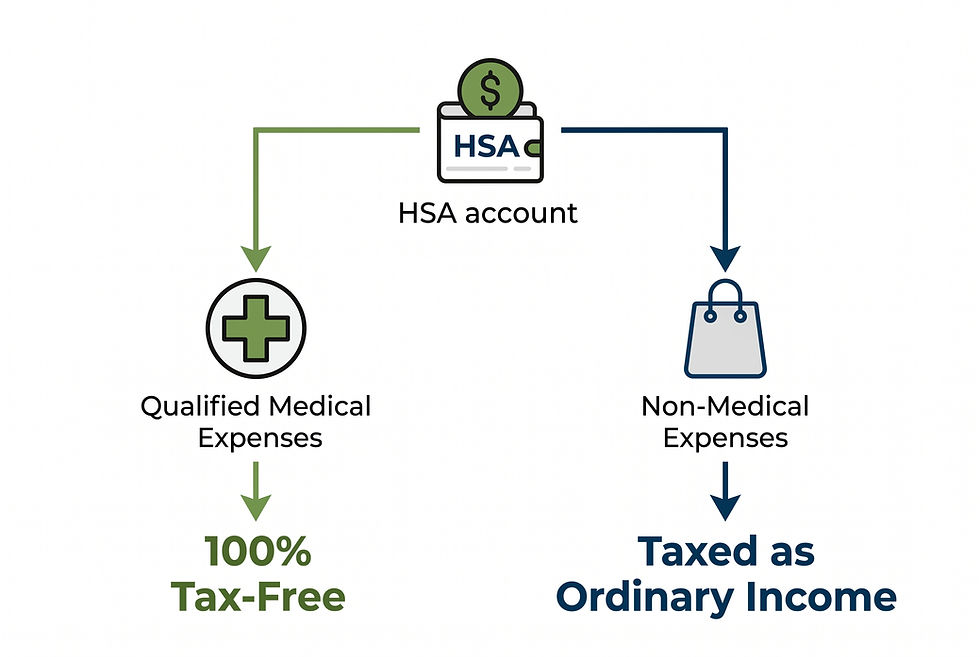
Medicare premiums (Parts A, B, D, and Medicare Advantage) are qualified medical expenses. You can pay them tax-free from the HSA after 65. Medigap (supplement) premiums are not considered qualified medical expenses.
Employer stock and the NUA election.
Do you hold employer company stock inside a 401(k)? The Net Unrealized Appreciation (NUA) election can split the tax treatment in your favor.
When you take a qualifying lump-sum distribution, the cost basis of the stock is taxed as ordinary income that year.
The net unrealized appreciation — the gain inside the plan — is later taxed at long-term capital gains rates when you sell. The holding period inside the 401(k) does not change that treatment (Fidelity — Net Unrealized Appreciation).
The catch. NUA is an all-or-nothing election. It requires a lump-sum distribution after a triggering event. Triggering events include separation from service, age 59½, disability, or death. The stock is taken in-kind to a taxable brokerage.
Most retirees default to a full IRA rollover. They lose access to the lower-rate treatment.
For executives at companies with deeply grown stock NUA reshapes the math.
It can change a high ordinary-bracket bill on the full position into a long-term-rate bill on most of it. On six- and seven-figure positions, the gap could be roughly nine percentage points of tax.
Learn more about the NUA election for stock.
The Hidden Connection: How Pulling From the Wrong Bucket Stacks the Tax Bill
Most articles describe each retirement income tax in isolation. The truth is they stack. A single $250,000 draw from a Traditional IRA may not just hit ordinary brackets.
It also pushes brokerage gains into a higher long-term capital gains bracket. It triggers the 3.8% Net Investment Income Tax. And it lifts your taxable income above the 0% capital gains harvest line.
That is why draw sequencing is such an underpriced lever in retirement tax planning. Here is the same Halverson couple. Same $5 million portfolio. Same $250,000 spending need. Multiple withdrawal options.
Unplanned Approach — Inaction (one-bucket): All $250,000 from the Traditional IRA. That clears the 22% bracket and dips into the 24% bracket on the top dollar. The senior bonus deduction phases out. Federal taxes could be well over $30,000.
Coordinated Approach — Coordinated withdrawals: Pull $50,000 from brokerage (with $20,000 of long-term gain). Pull $100,000 from the Traditional IRA. Pull $100,000 from the Roth. Ordinary income lands at about $134,000.
That fully uses the 12% bracket and stops short of the 22% bracket. The $20,000 of LTCG mostly falls in the 0% bracket. The senior bonus deduction is almost fully preserved. (MAGI stays just above the $150,000 phase-out start.) Federal tax: around $11,000.

The figure is calculated against the $5 million Halverson portfolio mix described above. It assumes a $250,000 yearly spending need. It assumes MFJ filing, both spouses age 67, 2026 federal brackets, and a 25-year retirement. Actual outcomes depend on your facts.
The same $250,000 spending needs. Three different tax bills.
When repeating the gaps across a 25-year retirement along with losing advantageous years for Roth Conversions, a large amount could go to the IRS instead of kids and family.
This is why full picture planning matters.
The Bottom Line: No single tax rate applies to "retirement income." Pensions, Traditional IRAs, and 401(k)s use the ordinary 10–37% brackets. Qualified Roth draws are tax-free. Brokerage gains and qualified dividends use the 0/15/20% schedule. Social Security, annuities, HSAs, and NUA-elected employer stock each follow their own rules. The order you tap these buckets — not just the size of your portfolio — drives the tax bill.
Not Sure If You're Making the Right Retirement Decisions?
Schedule a free Strategy Session to discuss your situation and get honest answers.
What's keeping you up at night about retirement
How we approach tax planning, income, and investments differently
Whether we're the right fit—or if you're better off on your own
No pressure. No obligation. Just an honest conversation.
Frequently Asked Questions
How is retirement income taxed in 2026?
Retirement income is taxed by source under different rules. Pensions, Traditional IRAs, and 401(k)s are taxed at ordinary federal rates of 10–37%. Qualified Roth draws are tax-free. Long-term capital gains and qualified dividends use the 0/15/20% schedule. Up to 85% of Social Security is taxed at ordinary rates for HNW retirees. (IRS — 2026 Tax Inflation Adjustments)
Which retirement income source has the lowest federal tax rate?
Qualified Roth IRA and Roth 401(k) draws carry the lowest federal rate. 0%. The account must be open at least five tax years. The owner must be at least 59½ (or meet a limited exception). Long-term capital gains taxed at 0% — for MFJ taxable income below $98,900 in 2026 — run a close second.
At what age is Social Security no longer taxed?
There is no age at which Social Security becomes tax-free. The federal taxability test is based on provisional income. Not on age. For HNW retirees, 85% of benefits stay taxable in nearly every year. Some states fully exempt Social Security at the state level. 38 of them, as of 2026.
What is the senior bonus deduction in 2026?
The senior bonus deduction is a new $6,000 federal income tax deduction added by the One Big Beautiful Bill Act. It is available 2025 through 2028 to filers age 65+, on top of the standard deduction and age-65 add-on (IRS — Senior Bonus Deduction Eligibility). It phases out at 6% of MAGI above $150,000 MFJ ($75,000 single).
Are RMDs taxed differently than other IRA withdrawals?
No. Required Minimum Distributions are taxed just like any other Traditional IRA or 401(k) draw — at ordinary federal rates. The "different" part is the timing. Not the rate. The IRS forces you to take them starting at age 73 (or 75 for those born in 1960 or later). The penalty for missed amounts is 25%.
Do I have to pay capital gains tax on my brokerage account in retirement?
Only when you sell. Holding grown assets without selling produces no capital gain. When you do sell, long-term gains (held more than one year) are taxed at 0%, 15%, or 20% based on your taxable income. A 3.8% NIIT surtax also applies if your MAGI exceeds $250,000 MFJ or $200,000 single (IRS — Topic No. 559). Heirs inherit your brokerage at a stepped-up basis. The gain dies with you for tax purposes.
Ready to get the help you need to retire with peace of mind?
Contact us today for a Free Strategy Session.

About the author:
Financial Advisor
Megan Waters is a CERTIFIED FINANCIAL PLANNER™ professional and Financial Advisor at Covenant Wealth Advisors. Megan has over 14 years of experience in the financial services industry.
Raised in Williamsburg, VA, Megan graduated from the Honors College at the College of Charleston with a BS in Economics and a minor in Environmental Studies.
Disclosures: Covenant Wealth Advisors is a registered investment advisor with offices in Richmond, Reston, and Williamsburg, VA. Registration of an investment advisor does not imply a certain level of skill or training. Past performance is no guarantee of future returns. Investing involves risk and possible loss of principal capital. The views and opinions expressed in this content are as of the date of the posting, are subject to change based on market and other conditions. This content contains certain statements that may be deemed forward-looking statements. Please note that any such statements are not guarantees of any future performance and actual results or developments may differ materially from those projected. Please note that nothing in this content should be construed as an offer to sell or the solicitation of an offer to purchase an interest in any security or separate account. Nothing is intended to be, and you should not consider anything to be, investment, accounting, tax, or legal advice. If you would like accounting, tax, or legal advice, you should consult with your own accountants or attorneys regarding your individual circumstances and needs. This article was written and edited by a CERTIFIED FINANCIAL PLANNER™ professional with the assistance of AI. No advice may be rendered by Covenant Wealth Advisors unless a client service agreement is in place. Hypothetical examples are fictitious and are only used to illustrate a specific point of view. Diversification does not guarantee against risk of loss. While this guide attempts to be as comprehensive as possible but no article can cover all aspects of retirement planning. Be sure to consult an advisor for comprehensive advice.


