
How Are Dividends Taxed? Qualified vs. Ordinary Dividend Rates Explained
- Andrew Casteel CFP®

- Mar 20
- 9 min read
Updated: Mar 21
Introduction
Frank and Diane Davila did everything right. Thirty-two years of saving. A $2.8 million portfolio. A comfortable retirement — until their CPA flagged a $4,500 annual tax leak they never saw coming.
Their dividend-heavy index funds were throwing off $50,000 a year. Solid income. But every dollar was sitting inside a traditional IRA.
And that single decision was converting what should have been a 15% tax rate into a 24% tax rate — on every dividend, every year.

[Disclosure: The scenario regarding Frank and Diane Davila is a hypothetical illustration used to demonstrate planning concepts. It does not represent the experience of actual clients. Hypothetical financial planning illustrations have inherent limitations, including that they are prepared with the benefit of hindsight and do not reflect actual results of any specific client situation.]
Over a 20-year retirement, that kind of mistake can cost as much as $170,000 in unnecessary taxes — depending on your bracket and whether the Medicare surtax applies.
And the Davilas aren't unusual. Most retirees don't realize how dividends are taxed — or that the location of their investments matters just as much as the investments themselves.
Key Takeaways
Qualified dividends are taxed at 0%, 15%, or 20% — the same preferential rates as long-term capital gains. Ordinary dividends are taxed at your regular income tax rate, up to 37%.
The holding period is the gatekeeper. You must own the stock for more than 60 days in a specific 121-day window, or your dividend loses its "qualified" status.
A 3.8% surtax applies above $250,000 (married filing jointly) — the Net Investment Income Tax hits both qualified and ordinary dividends and is not indexed for inflation.
Where you hold dividend stocks changes the tax rate. Qualified dividends inside a traditional IRA lose their preferential rate entirely and come out as ordinary income — potentially doubling the tax.
The cost of getting this wrong: up to $8,500 per year on $50,000 in dividends, or roughly $170,000 over a 20-year retirement.
Qualified vs. Ordinary Dividends: The Label That Sets Your Tax Rate
Not all dividends are taxed the same. The IRS splits them into two categories — qualified and ordinary (also called nonqualified) — and the difference in tax rates can be enormous.
Ordinary dividends are the default. They're taxed at your regular federal income tax rate, which ranges from 10% to 37% under the rate structure made permanent by the One Big, Beautiful Bill Act (OBBBA), signed July 4, 2025 (IRS Topic 404).
If you're a retiree with $250,000 in taxable income, your ordinary dividends are taxed at 24% or higher.
Qualified dividends get a discount. They're taxed at the same preferential rates as long-term capital gains: 0%, 15%, or 20%, depending on your taxable income (IRS Topic 409).
But a dividend doesn't earn "qualified" status automatically. Two tests must be met:
The payer test. The dividend must come from a U.S. corporation or a qualifying foreign corporation. Most S&P 500 and total market index funds pass this easily. REITs usually do not — their dividends are generally ordinary income.
The holding period test. You must hold the stock for more than 60 days during the 121-day window that begins 60 days before the ex-dividend date (IRS Publication 550). Sell too early, and the dividend reverts to ordinary.

Your 1099-DIV breaks this out for you. Box 1a shows total ordinary dividends. Box 1b shows the qualified portion. If you've never compared those two numbers, now is the time.
Dividend Tax Rates for 2025 and 2026
The OBBBA made the Tax Cuts and Jobs Act (TCJA) rate structure permanent. That means the qualified dividend rates of 0%, 15%, and 20% are no longer set to expire — they're embedded in the tax code for good (TLD Law — OBBBA Individual Tax Changes).
Here are the current thresholds for married filing jointly:
2025 Qualified Dividend Rates (MFJ) (IRS Rev. Proc. 2024-40)
0% on taxable income up to $96,700
15% on taxable income from $96,701 to $600,050
20% on taxable income above $600,050
2026 Qualified Dividend Rates (MFJ) (IRS Rev. Proc. 2025-32)
0% on taxable income up to $98,900
15% on taxable income from $98,901 to $613,700
20% on taxable income above $613,700
For ordinary dividends, you'll pay your marginal income tax rate. In 2026, the 24% bracket for married filers covers taxable income from $211,401 to $403,550 (Tax Foundation — 2026 Tax Brackets). That's the bracket most affluent retirees land in.
The bottom line: on the same $50,000 in dividends, a couple in the 24% ordinary bracket pays $12,000. If those dividends are qualified, they pay $7,500 at the 15% rate. That's a $4,500 difference — every single year.
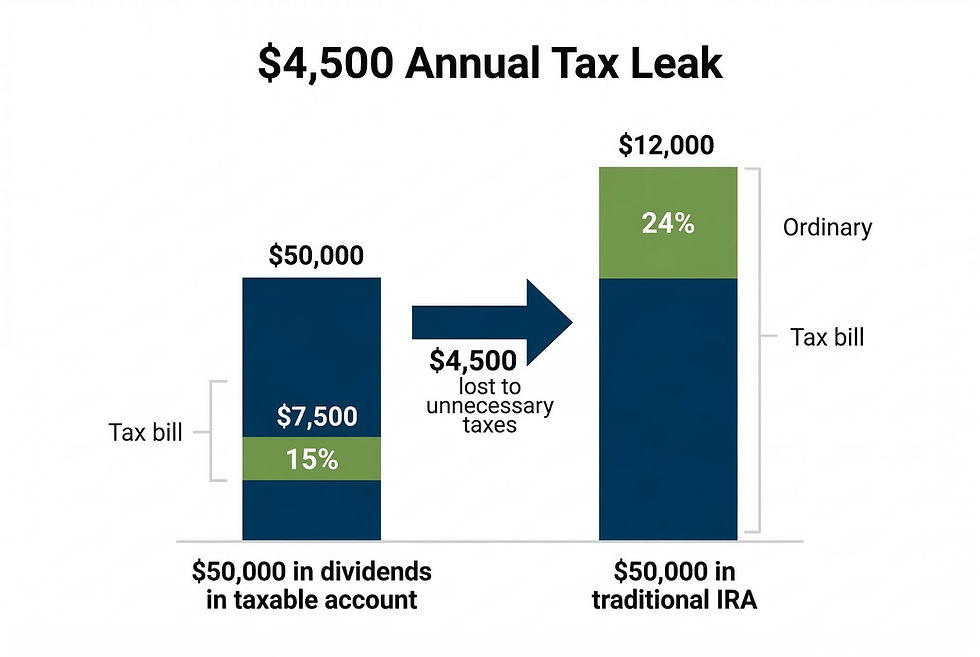
This is the section to forward to your CPA or to revisit when you're evaluating how retirement account withdrawals impact your tax bracket.
The 3.8% Surtax Most Retirees Overlook
The rates above aren't the whole story. If your modified adjusted gross income (MAGI) exceeds $250,000 for married filers — or $200,000 for single filers — you'll also owe the Net Investment Income Tax (NIIT).
That's an extra 3.8% on all investment income, including every dividend.
Here's what makes the NIIT dangerous: those $250,000/$200,000 thresholds have not been adjusted for inflation since they took effect in 2013.
They're written into the statute at fixed dollar amounts. The OBBBA did not change them. Every year, inflation pushes more retirees over the line.
That means the real maximum tax rate on qualified dividends is 23.8% (20% + 3.8%). On ordinary dividends, it's 40.8% (37% + 3.8%).
On $50,000 in dividends, the spread between those two rates is approximately $8,500 per year. Over a 20-year retirement, that's up to $170,000 — just from the difference between how your dividends are classified.
One more wrinkle for REIT investors: Most REIT dividends are taxed as ordinary income, not qualified dividends. However, the Section 199A deduction — now made permanent by the OBBBA — lets you deduct 20% of qualified REIT dividends from your taxable income (IRS — Qualified Business Income Deduction).
That effectively drops the top federal rate on REIT dividends from 37% to about 29.6%. It helps, but it still doesn't match the 20% qualified rate — and it doesn't reduce your AGI, which matters for other thresholds or change the inherent tax efficiency of ETFs used for income.
What Your IRA Does to Your Dividend Tax Rate
Here's what most advisors don't explain — and it's the single most expensive blind spot in dividend planning for retirees who are searching for the best investments for income in retirement.
Qualified dividends earned inside a taxable brokerage account keep their preferential tax rate. A couple with $200,000 in taxable income pays just 15% on those dividends.
But the same qualified dividends earned inside a traditional IRA lose that status entirely. When you withdraw the money, every dollar comes out as ordinary income — taxed at your marginal rate.
For that same couple, that's 24%. The dividend's "qualified" label disappears the moment it enters a traditional IRA.
Think of it this way: your IRA is like a black box. Everything that goes in — capital gains, qualified dividends, interest — comes out the same color: ordinary income. The tax code doesn't care what generated the growth.
The Numbers That Matter
The Davila scenario in three acts:
❌ Inaction: $50,000 in qualified dividends held inside a traditional IRA. Taxed at 24% ordinary rate on withdrawal = $12,000/year in taxes.
⚠️ Generic advice: "Put your dividend stocks in a retirement account for tax-deferred growth." Sounds smart. Costs them $4,500/year in lost preferential rates.
✅ Optimized strategy: Move dividend-paying equities to the taxable brokerage account where they're taxed at 15%, coordinating this with a broader plan for reducing capital gains tax on stocks. Shelve high-yield bonds and REITs in the IRA where they'd be taxed at ordinary rates anyway.
Annual savings: $4,500. 20-year savings: $90,000.
The trade-off is real: tax-deferred growth inside the IRA has value, especially for high-turnover funds that generate frequent taxable events.
This isn't a universal rule. It depends on your tax bracket, your time horizon, and whether the NIIT applies. But for retirees already taking withdrawals, the math often favors holding qualified-dividend stocks outside the IRA.
Forward this section to your CPA and ask: "Are my dividend-paying funds in the right accounts — or am I converting qualified dividends into ordinary income?"
This is also a great time to consider questions to ask your financial advisor about your tax plan.
Check This Now
Here's what you can check right now — before your next meeting with an advisor.
Pull your most recent 1099-DIV. Compare Box 1a (total dividends) to Box 1b (qualified dividends). If Box 1b is much smaller than 1a, you're paying ordinary rates on most of your dividend income.
Check which account holds your dividend funds. Log into your brokerage and IRA accounts. Are dividend-heavy equity funds sitting inside your traditional IRA? If yes, you may be losing the qualified rate.
Look at last year's tax return, Line 3a (qualified dividends) vs. Line 3b (ordinary dividends). Note that Line 3a is a subset of Line 3b — so if 3a is much smaller than 3b, most of your dividends are being taxed at your full marginal rate.
Check your MAGI against the NIIT threshold. If your joint MAGI exceeded $250,000 in 2025, you owe an extra 3.8% on every dividend — qualified or not, so it may be worth exploring broader strategies to minimize taxes on retirement income.
[Disclosure: The information above is provided for educational purposes to help you evaluate your own situation. It is not personalized financial advice. Your specific circumstances may differ — consult a qualified financial professional before making changes to your plan.]

Over a 20-year retirement, the difference between getting dividend taxation right and wrong can reach $170,000. That's not a rounding error. It's a retirement year — or two.
Want Our Team to Just Do Your Retirement Planning for You? Schedule Your Strategy Session!
Investment Management — built around your retirement income needs, not a generic model
Tax Planning For Retirement — Roth conversions, withdrawal sequencing, IRMAA strategies
Retirement Income Planning — a clear plan so you know your money won't run out
Award Winning* | Fee-Only Fiduciary | Serving Clients Nationwide
Frequently Asked Questions
What is the Difference Between Qualified and Ordinary (Nonqualified) Dividends?
Understanding this difference is a key input to tax-efficient IRA withdrawal strategies that can maximize your savings.
Qualified dividends come from U.S. corporations (or qualifying foreign ones) and meet a minimum holding period. They're taxed at 0%, 15%, or 20%. Ordinary dividends don't meet these tests and are taxed at your regular income tax rate — up to 37% in 2026 (IRS Topic 404).
What Are the Current Dividend Tax Rates?
For 2026, qualified dividends are taxed at 0% (up to $98,900 MFJ), 15% (up to $613,700 MFJ), or 20% (above $613,700). Ordinary dividends are taxed at your marginal income rate, from 10% to 37%. An additional 3.8% NIIT may apply above $250,000 MAGI (IRS Rev. Proc. 2025-32).
Are Dividends Taxed in Retirement Accounts?
Dividends interact with required minimum distributions in complex ways, so it helps to review an essential guide to RMD tax strategies alongside the rules below.
Dividends inside a traditional IRA grow tax-deferred, but all withdrawals are taxed as ordinary income — even if the dividends were "qualified." In a Roth IRA, qualified withdrawals are entirely tax-free. This makes account selection a critical tax decision (IRS Publication 550).
What is the Holding Period Requirement for Qualified Dividends?
Your holding period, combined with the timing of withdrawals and RMDs, can influence your taxes; many retirees pair these rules with strategies to lower taxable income once RMDs begin.
You must hold the stock for more than 60 days within the 121-day period starting 60 days before the ex-dividend date. Days when your risk of loss is reduced — through short sales or options — don't count (IRS Topic 404).
Ready to get your retirement portfolio on track?
Contact us today for a Free Strategy Session.

About the author:
Chief Investment Officer
Andrew is the Chief Investment Officer for Covenant Wealth Advisors and a CERTIFIED FINANCIAL PLANNER™ practitioner. He has over 11 years of experience in the financial services industry in the areas of wealth management and financial planning for retirement.
Disclosures: Covenant Wealth Advisors is a registered investment advisor with offices in Richmond, Reston, and Williamsburg, VA. Registration of an investment advisor does not imply a certain level of skill or training. Past performance is no guarantee of future returns. Investing involves risk and possible loss of principal capital. The views and opinions expressed in this content are as of the date of the posting, are subject to change based on market and other conditions. This content contains certain statements that may be deemed forward-looking statements. Please note that any such statements are not guarantees of any future performance and actual results or developments may differ materially from those projected. Please note that nothing in this content should be construed as an offer to sell or the solicitation of an offer to purchase an interest in any security or separate account. Nothing is intended to be, and you should not consider anything to be, investment, accounting, tax, or legal advice. If you would like accounting, tax, or legal advice, you should consult with your own accountants or attorneys regarding your individual circumstances and needs. This article was written and edited by a CERTIFIED FINANCIAL PLANNER™ professional with the assistance of AI. No advice may be rendered by Covenant Wealth Advisors unless a client service agreement is in place. Hypothetical examples are fictitious and are only used to illustrate a specific point of view. Diversification does not guarantee against risk of loss. While this guide attempts to be as comprehensive as possible, no article can cover all aspects of retirement planning. Be sure to consult an advisor for comprehensive advice.


